
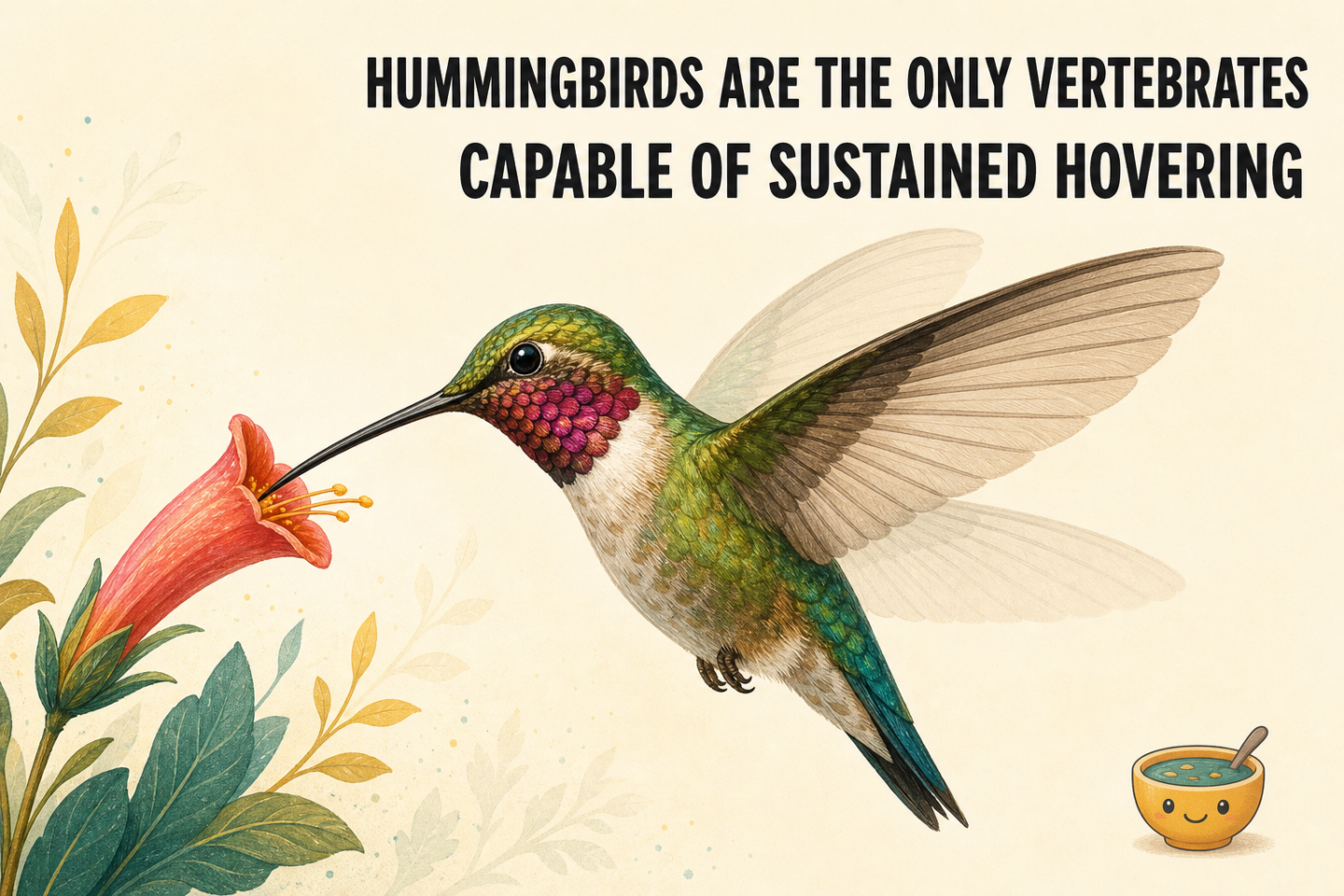
A hummingbird beside a flower can seem almost motionless. The bird is not resting on invisible air. It is actively flying while holding nearly the same position, a feat called sustained hovering.
According to Smithsonian’s National Zoo and Conservation Biology Institute, hummingbirds are the only vertebrates capable of sustained hovering. The same source points to a crucial part of their flight: hummingbirds and their close relatives, swifts, can stroke with power on both the downbeat and upbeat of a wing flap.
Both halves of the wing flap do work
A wing flap has two obvious halves. The wing moves down, then returns upward. Smithsonian describes hummingbirds as able to apply power during both parts rather than treating the return movement as merely a reset.
That does not make the bird motionless. Its wings are moving rapidly while its body holds position. The image therefore shows two restrained wing-position echoes, not a frozen pair of wings. They represent powered movement on the two halves of a flap without pretending to trace a precise aerodynamic path.
Smithsonian connects this two-direction power stroke, together with the birds’ small size, to their tremendous agility. The result is flight control that looks startlingly unlike ordinary forward travel: a hummingbird can stay at a flower, reverse direction, or turn its body into an unusual orientation without landing first.
Why the word “sustained” matters
The memorable claim is precise. It is not simply that a hummingbird can look still for an instant. Smithsonian defines the ability as staying in one place during flight and uses the qualifier “sustained.” The bird keeps producing controlled flight rather than passing through one momentary position.
This is especially useful at flowers. A hummingbird can remain in front of a bloom while feeding instead of needing a perch. During the breeding season, Smithsonian also notes that hummingbirds hover in midair to catch small flying insects, which they eat and feed to their nestlings.
Hovering is therefore more than a visual trick. It gives the bird a way to work in a small patch of air—feeding from a flower or intercepting an insect—while keeping its body close to the target.
Hovering is one part of a larger flight toolkit
The same control shows up when a hummingbird moves backward or flies upside down. These maneuvers should not be confused with the central claim: sustained hovering means holding position. Backward and upside-down flight are separate examples of the agility described by Smithsonian.
The distinction keeps the fact from turning into a vague claim that hummingbirds are simply “good at flying.” Their exceptional ability has a visible boundary. The body stays near one point, the wings continue working, and the bird remains free to leave in more than one direction.
What to watch for at a flower
If you see a hummingbird feeding, watch the relationship between the bird and the bloom. The flower stays fixed. The bird’s body holds its place. Around that apparently quiet center, the wings are doing the work that makes the stillness possible.
That contrast is the satisfying part of the fact. The only vertebrate capable of sustained hovering achieves stillness through continuous motion.