
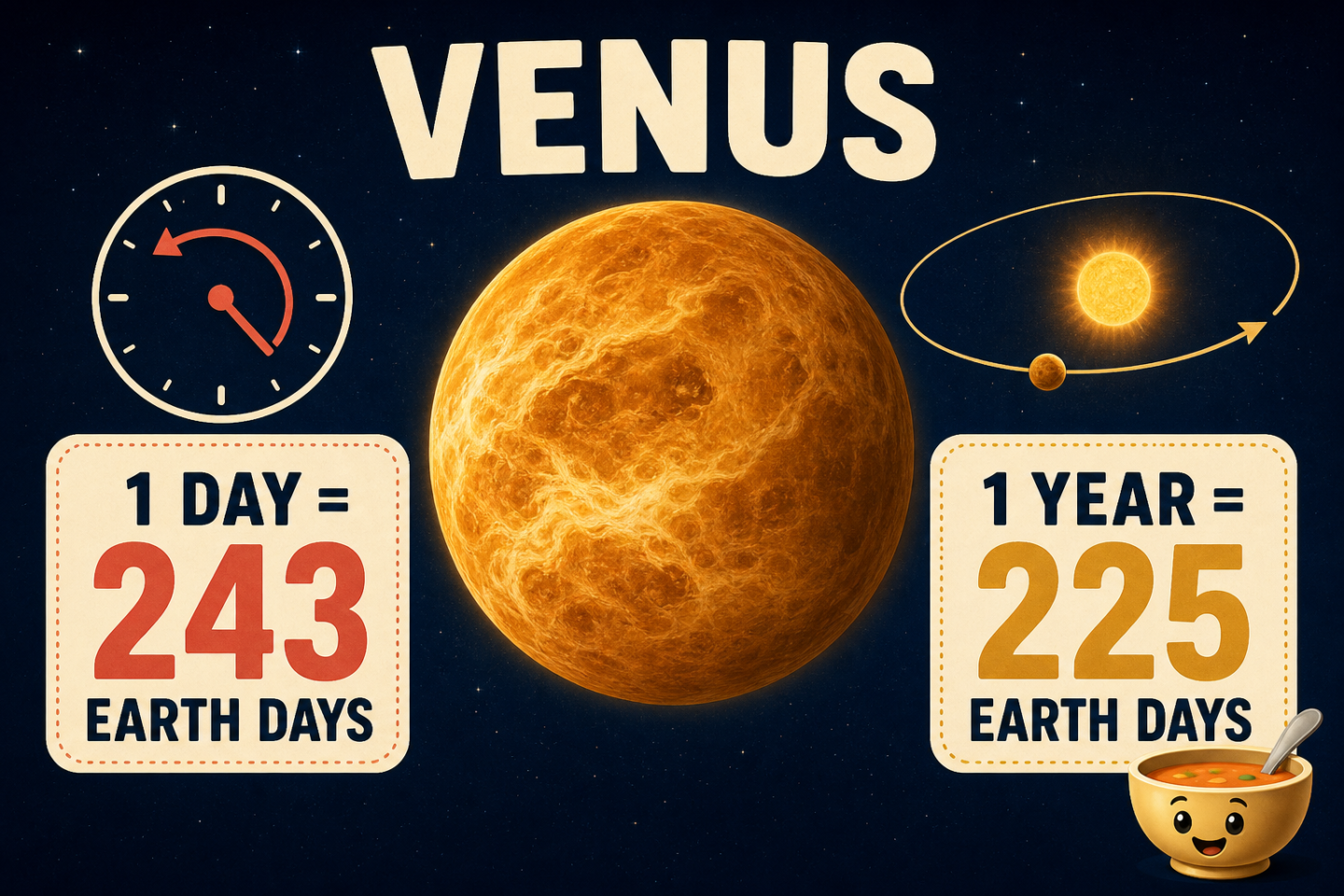
A day on Venus is longer than a year on Venus. That sounds like a riddle, but it follows directly from the planet’s unusually slow rotation. Venus takes about 243 Earth days to turn once on its axis, while it completes an orbit around the Sun in about 225 Earth days. By the time the planet has finished one rotation, its year is already over.
The comparison is a vivid reminder that a day and a year measure two different motions. A planet’s day is tied to rotation, while its year is tied to its journey around its star. On Earth, rotation is fast and revolution is slow: our planet turns roughly once every 24 hours but needs about 365 days to orbit the Sun. Venus reverses that familiar relationship.
Rotation and revolution are different clocks
When scientists describe the 243-day rotation of Venus, they are measuring how long the planet takes to turn once relative to distant stars. This is often called a sidereal rotation period. The 225-day year measures a separate motion: the time Venus needs to travel once around the Sun.
These two cycles do not have to resemble each other. A world can rotate quickly or slowly regardless of how long its orbit takes. Distance from the Sun strongly affects orbital period, but rotation depends on a planet’s history, including the motion it inherited during formation and the forces that acted on it later.
Venus is the second planet from the Sun, orbiting at an average distance of about 67 million miles, or 108 million kilometers. Being closer to the Sun than Earth helps give Venus its shorter 225-day orbit. Its exceptionally slow spin creates the more surprising half of the comparison.
Why sunrise to sunset is 117 Earth days
There is another definition of a day: the solar day, measured from one noon to the next or from one sunrise to the next. On Venus, that cycle lasts about 117 Earth days rather than 243. The numbers differ because Venus is rotating while also moving along its orbit. The apparent position of the Sun in the sky depends on both motions at once.
This means that a visitor somehow protected from the planet’s extreme heat and pressure would wait about 117 Earth days between sunrises. That is still an astonishingly long day, but it is shorter than the time Venus needs to complete one turn relative to the stars.
The Sun would rise in the west
Venus also rotates in the opposite direction from Earth and most other planets. Seen from above the north side of the solar system, most planets rotate counterclockwise. Venus turns clockwise, a pattern known as retrograde rotation.
As a result, the Sun on Venus would appear to rise in the west and set in the east. The direction is the reverse of what people see on Earth. Venus is not the only planet with an unusual orientation, but the combination of retrograde rotation and an extremely slow spin makes its day-night cycle distinctive.
A planet with little seasonal change
Earth’s axis is tilted by about 23 degrees, producing strong seasonal changes as the planet orbits the Sun. Venus has a tilt of only about three degrees when its retrograde orientation is described in this way. NASA notes that this is too small to create noticeable seasons like those on Earth.
That does not make Venus mild. Its dense carbon-dioxide atmosphere traps heat through a runaway greenhouse effect. NASA lists a surface temperature of about 872 degrees Fahrenheit, or 467 degrees Celsius, and surface pressure about 93 times Earth’s pressure at sea level. The planet’s long day therefore unfolds under conditions far more extreme than any ordinary seasonal variation.
Why the comparison matters
The idea that a day should be shorter than a year comes from living on Earth, not from a universal rule. Every planet carries a different combination of rotation, orbit, tilt and direction. Venus happens to place those variables in an arrangement that turns an everyday word like day into something wonderfully unfamiliar.
Its 243-day rotation and 225-day orbit are not competing estimates. They describe two separate celestial clocks. Put them together, and Venus completes an entire year before it completes a single turn relative to the stars.