
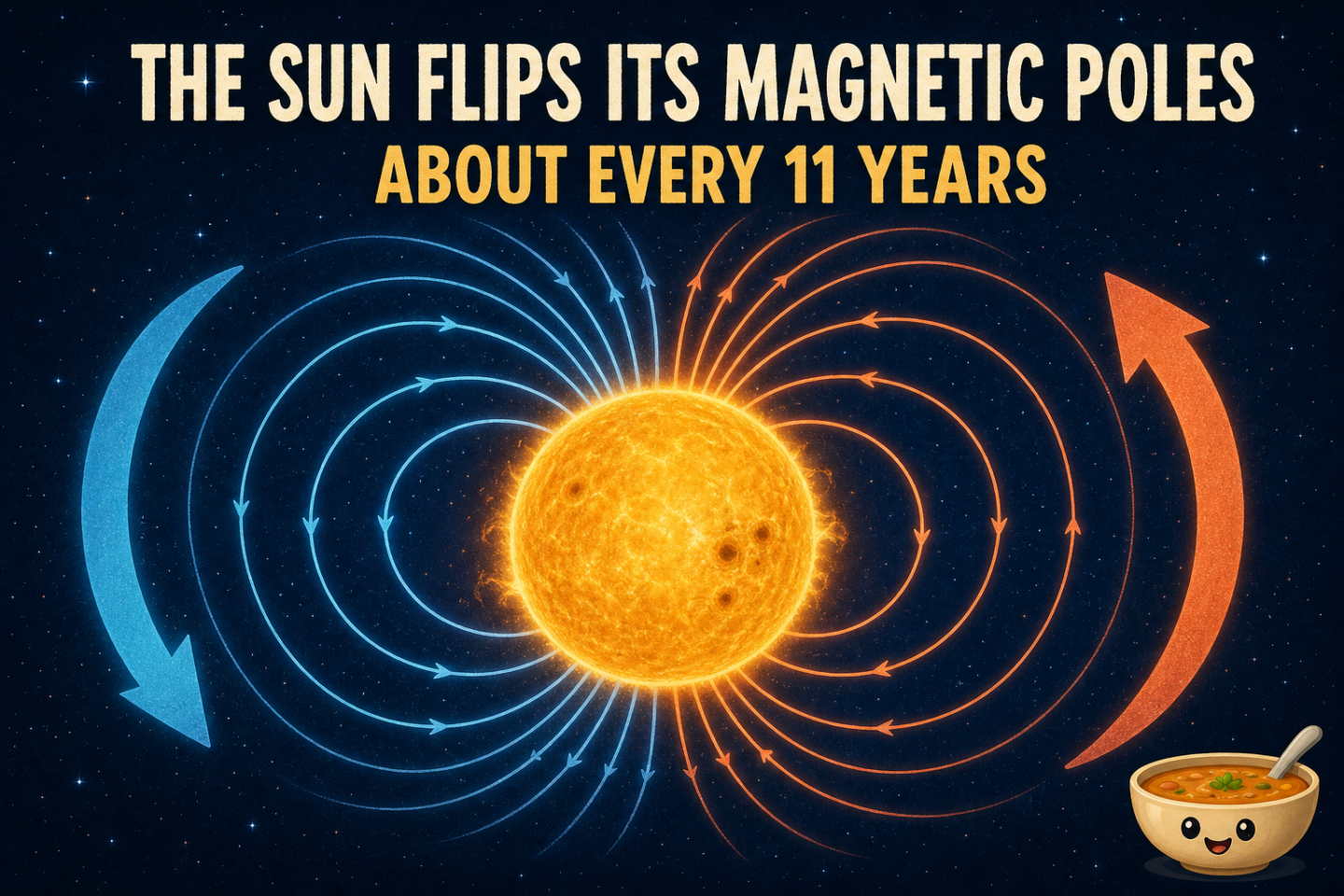
The Sun has a north magnetic pole and a south magnetic pole, but they do not keep the same orientation forever. Approximately every 11 years, the Sun’s global magnetic polarity reverses. Magnetic north becomes magnetic south, and magnetic south becomes magnetic north.
This reversal is a normal part of the solar cycle, the recurring rise and fall of magnetic activity on our star. It is also one of the clearest reminders that the Sun is not a quiet, unchanging ball of light. It is a dynamic sphere of electrically charged plasma with a magnetic field that continually evolves.
What actually flips?
The Sun does not physically turn upside down, and its geographic poles do not trade locations. What changes is the polarity of its large-scale magnetic field. During a reversal, the polar magnetic fields weaken, pass through a complicated transitional state, and emerge with the opposite orientation.
Earth’s magnetic field has reversed many times in the planet’s history, but the Sun does it on a much shorter and more regular timescale. The solar reversal occurs near the active portion of the cycle, when magnetic activity and sunspot numbers are high.
Why the Sun has a magnetic cycle
The Sun is made mostly of plasma: hot matter whose atoms have been separated into electrically charged particles. This material moves, circulates, and rotates. Because moving electric charges create magnetic fields, the motion inside the Sun drives a vast magnetic system.
The Sun also rotates differently from a solid object. Its equatorial regions complete a turn faster than regions closer to the poles. Motions within the solar interior stretch, twist, and reorganize magnetic fields. Scientists use observations and models to study this solar dynamo, but the visible result is unmistakable: activity rises, reaches a maximum, declines, and begins again.
Sunspots act like markers
Sunspots are darker patches on the Sun’s visible surface. They are not holes. They look dark because they are cooler than the surrounding photosphere, although they remain extremely hot. Strong concentrations of magnetic field suppress some of the normal movement of hot material, allowing a region to cool relative to its surroundings.
The number of sunspots changes with the solar cycle. Around solar minimum, the Sun may show few spots. As magnetic activity increases, more spots and active regions appear. Around solar maximum, the Sun is usually more freckled and more likely to produce energetic events such as solar flares and coronal mass ejections.
A single sunspot can last from days to months, while the population of spots across the whole Sun provides a long-running measure of solar activity. Astronomers have tracked sunspots for centuries, creating one of science’s longest records of a repeating natural phenomenon.
Eleven years or twenty-two?
Both numbers are useful, but they describe different ways of counting. The familiar solar activity cycle takes about 11 years from one minimum to the next. Near the active peak, the magnetic poles reverse.
After one reversal, the polarity is opposite its starting orientation. It takes another roughly 11-year cycle and another reversal to return magnetic north and south to their earlier arrangement. For that reason, researchers also describe a complete magnetic pattern known as the 22-year Hale cycle.
The timing is approximate rather than clockwork. Individual cycles differ in length and strength, which is why scientists continuously observe sunspots, polar fields, and other indicators instead of relying on a calendar alone.
Why the cycle matters beyond the Sun
The Sun’s changing magnetic activity shapes space weather. Flares can release intense radiation, while coronal mass ejections can send large clouds of magnetized plasma into space. When such disturbances interact with Earth’s magnetic environment, they can produce auroras and, in stronger cases, affect satellites, radio communication, navigation, astronauts, and electrical infrastructure.
Not every sunspot produces an eruption, and solar maximum does not mean constant danger. It means that the conditions associated with solar eruptions are generally more common. Tracking the cycle helps scientists describe the Sun’s current state and prepare systems that operate in space or depend on space-based technology.
A star with a changing compass
From Earth, the Sun can look steady from day to day. On the scale of years, however, its magnetic personality changes dramatically. Dark spots multiply, activity rises, the global field reverses, and the star gradually settles toward a quieter phase before the pattern begins again.
The phrase “the Sun flips its poles” sounds almost impossible, but it describes a regular feature of our nearest star. The Sun carries a magnetic compass large enough to influence the entire solar system, and roughly once every 11 years, that compass points the other way.