
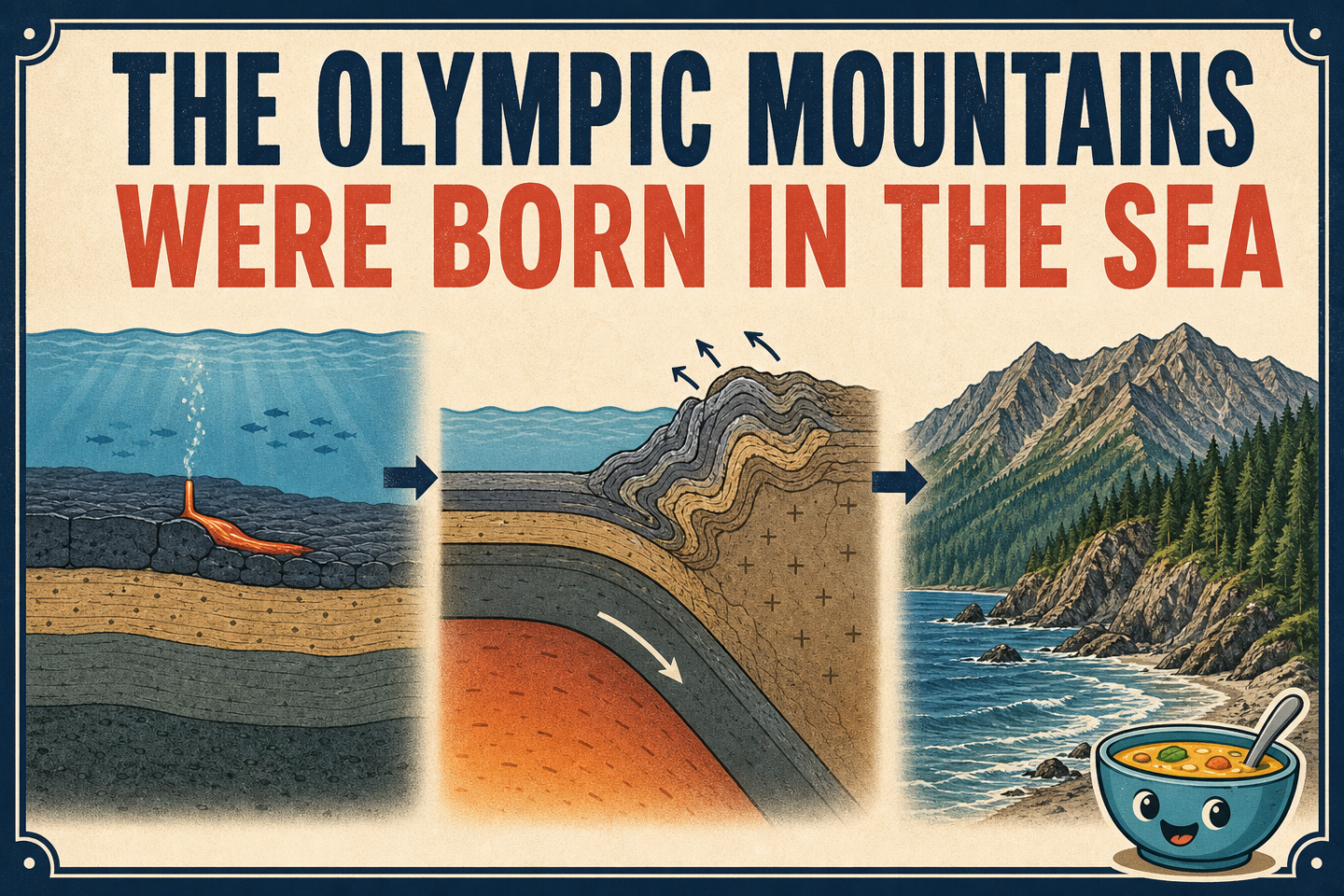
The Olympic Mountains of Washington look firmly rooted to the continent, but the National Park Service gives them a more surprising birthplace: the sea. The basalts and sedimentary rocks that make up much of the range were laid down offshore 18 to 57 million years ago. They were later uplifted, bent, folded, and eroded into the peaks visible today.
That history turns a mountain range into a biography of moving rock. It begins with lava and sediment on an ancient ocean floor, passes through a collision between tectonic plates, and continues with uplift and erosion that are still reshaping the landscape.
Chapter one: rock forms beneath the ocean
The presence of basalt might make the Olympic Mountains sound like a chain of volcanoes. NPS makes an important distinction: the Olympic range is not volcanic. Its basalt belongs to an earlier setting.
Underwater volcanoes erupted on the ocean floor, where lava cooled into basalt. Sand, mud, and other sediment also accumulated offshore. Over millions of years, those materials hardened into the basalt and sedimentary rocks that would eventually become mountain mass.
Chapter two: not every layer goes down
The next part of the story is subduction. NPS describes the Juan de Fuca Plate being forced beneath the North American Plate. That downward motion does not carry every layer of material smoothly into the Earth.
The agency compares the process to scraping a layer from a surface. As oceanic crust descends, sedimentary rock built up on top can be compressed against the continent. Those upper layers crumple, fold, and rise instead of following all of the deeper plate downward.
This is why the image for this story needs two motions at once. One plate descends, but some of the material above it is pushed upward. Showing only an arrow going underground would miss the part that makes mountains.
Chapter three: seafloor becomes high country
The transformation is not merely theoretical. At Hurricane Ridge and Mount Angeles, NPS points to former pieces of ocean floor standing just shy of 6,000 feet above sea level. Layers that once settled horizontally can now appear steeply tilted after compression and uplift.
Mount Olympus, the tallest peak in the range, reaches 7,980 feet. That number does not mean the same individual slab rose directly from one fixed depth to the summit. It shows the scale of a landscape assembled and reshaped through many stages of deformation, uplift, and erosion.
The mountains are rising and wearing away
The Olympic Mountains are not a finished monument. NPS says the plates continue to converge and the range is still being uplifted. At the same time, the wet and snowy climate gives erosion enormous power.
Rain feeds rivers that cut valleys. Snow accumulates into glaciers that move and grind rock. NPS notes that erosion occurs at a rate that makes the uplift insignificant in the overall sum. The range can keep receiving an upward tectonic push while its surface is simultaneously carved down.
A mountain range with an ocean-floor memory
The phrase “born in the sea” is memorable because it compresses a long sequence into one image. But the full story is better: underwater eruptions created basalt, sediment accumulated above the ocean floor, subduction compressed the upper layers, and uplift raised folded rock into the air. Erosion then sculpted the raw rise into the rugged Olympic Mountains.
The peaks are therefore not evidence of a modern volcanic chain. They are evidence that rock can change location, orientation, and identity on a timescale far longer than a human life. A mountain can preserve its first chapter even after the sea is far below.