
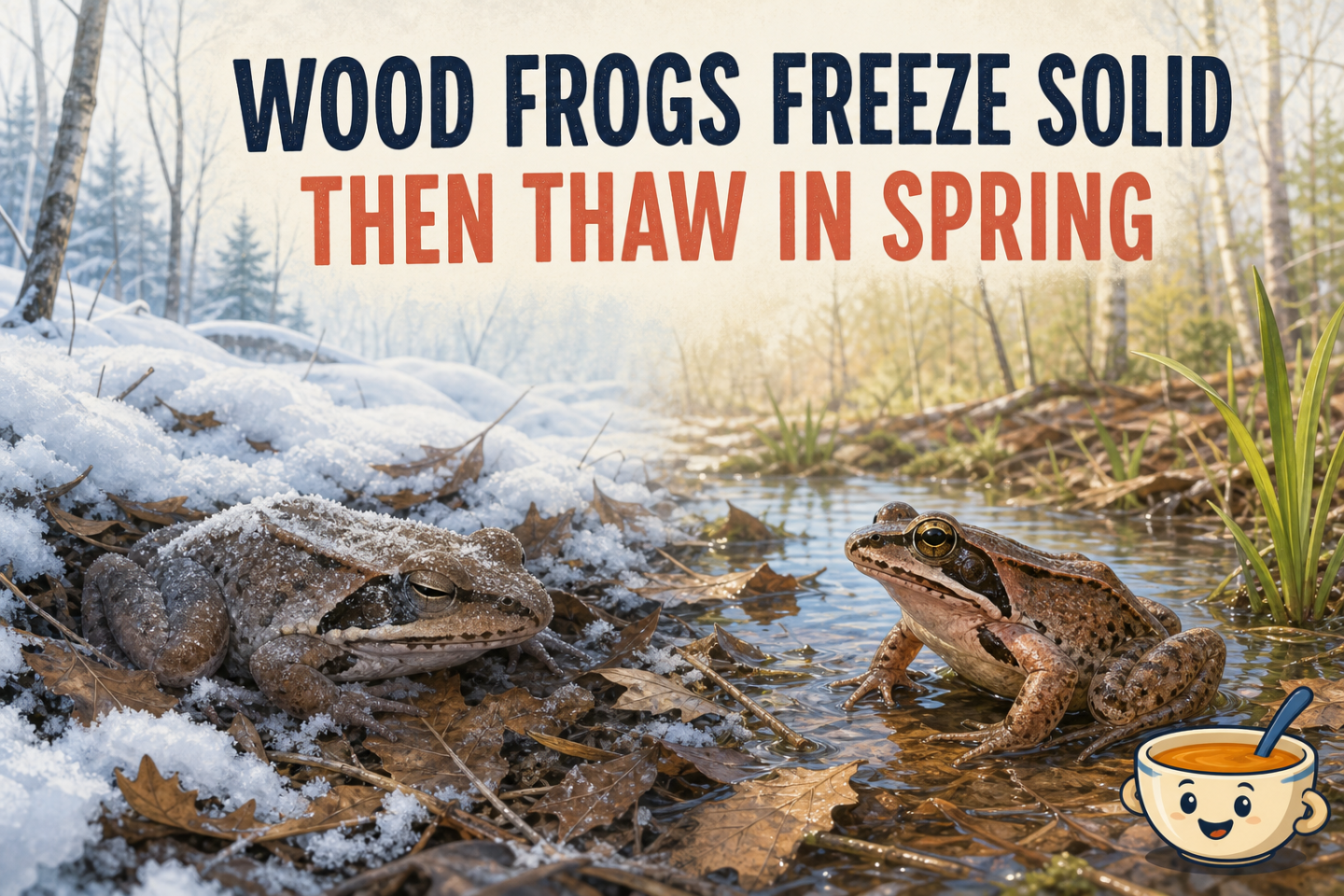
A wood frog can spend the northern winter frozen, with no heartbeat, no breathing, and no muscle movement. It survives because freezing is controlled rather than prevented completely: ice forms around the outsides of cells and organs, while glucose released by the liver helps keep ice from forming inside the cells and limits the water loss that would damage them.
That distinction is the key to the apparent paradox. The frog is not warm, active, or secretly breathing beneath the snow. The National Park Service describes it as alive in a state of suspended animation. The remarkable part is not that the frog avoids freezing, but that its tissues endure a carefully bounded form of it.
A winter shelter that still freezes
Many northern frogs escape freezing by hibernating deep underwater. Wood frogs use another strategy. They settle into leaves and duff on the forest floor, with snow providing additional insulation. That cover softens the extremes, but it does not isolate them from temperatures below freezing.
The National Park Service says researchers have found that wood frogs spend the winter frozen and can remain in that condition for up to eight months each year. This land-based strategy also has a seasonal advantage. The ground thaws and warms sooner than ice-covered lakes, so wood frogs can become active early and use small ponds or meltwater pools for breeding.
The danger is ice in the wrong place
Freezing is normally destructive because ice can disrupt circulation and injure cells. As water is pulled away, cells can dehydrate and their internal structure can be damaged. A wood frog does not make those dangers disappear. Instead, its freeze tolerance depends on separating ice outside cells from the protected liquid inside them.
At the beginning of winter, ice quickly fills the frog’s abdominal cavity and encases its internal organs. Crystals also form between layers of skin and muscle. Even the lenses of its eyes freeze and turn white. These are real physical changes, not a loose comparison to an animal that merely becomes very cold.
Glucose protects the cells
As freezing begins, the liver produces large amounts of glucose, which moves into cells throughout the body. The National Park Service explains that this sugar-rich solution helps prevent the cells themselves from freezing and binds water molecules inside them, reducing dehydration.
So the mechanism has two coordinated sides. The body permits ice around the outsides of cells and organs, but resists ice formation inside the cells. “Frozen solid” is a useful description of the motionless frog, yet it should not be read as meaning that every living cell becomes a block of ice. The survival boundary is microscopic: where the ice forms matters.
Thawing has an order
During winter, the frog appears inert: no muscle movement, heartbeat, or breathing. In spring, it thaws from the inside outward. The heart starts beating first, then the brain activates, and finally the legs move. The National Park Service also notes that what restarts the heart after the long frozen period is not yet understood.
Once thawed, the frog moves through the woods toward suitable breeding water. That completes a cycle in which a fragile-looking amphibian does not defeat winter by staying warm. It survives by controlling the boundary between harmful intracellular ice and ice its body can tolerate—then reversing the process in a specific sequence when spring returns.