
Jupiter’s moon Io is the most volcanically active world in the solar system. Hundreds of volcanoes mark its surface, and some produce lava fountains that rise dozens of miles, according to NASA. The energy behind this activity comes from gravity repeatedly flexing Io itself.
This mechanism is called tidal heating. Jupiter supplies the dominant gravitational pull, while the neighboring moons Europa and Ganymede add smaller, precisely timed tugs. Together, those forces keep Io’s orbit slightly irregular and make its solid surface rise and fall by an astonishing amount.
A gravitational tug-of-war
The NASA Science Io Facts page describes Io’s volcanism as the result of a tug-of-war. Jupiter’s immense gravity pulls strongly on Io. Europa and Ganymede orbit farther from Jupiter, but their recurring gravitational pulls perturb Io’s path into an irregularly elliptical orbit.
As Io travels around Jupiter, its distance from the giant planet varies. The strength and direction of the stress across the moon therefore vary as well. Io also keeps the same side facing Jupiter, but the changing forces continually deform its interior and surface. This is a tide in the broad physical sense: gravity stretches an orbiting body unevenly.
Solid ground can have tides
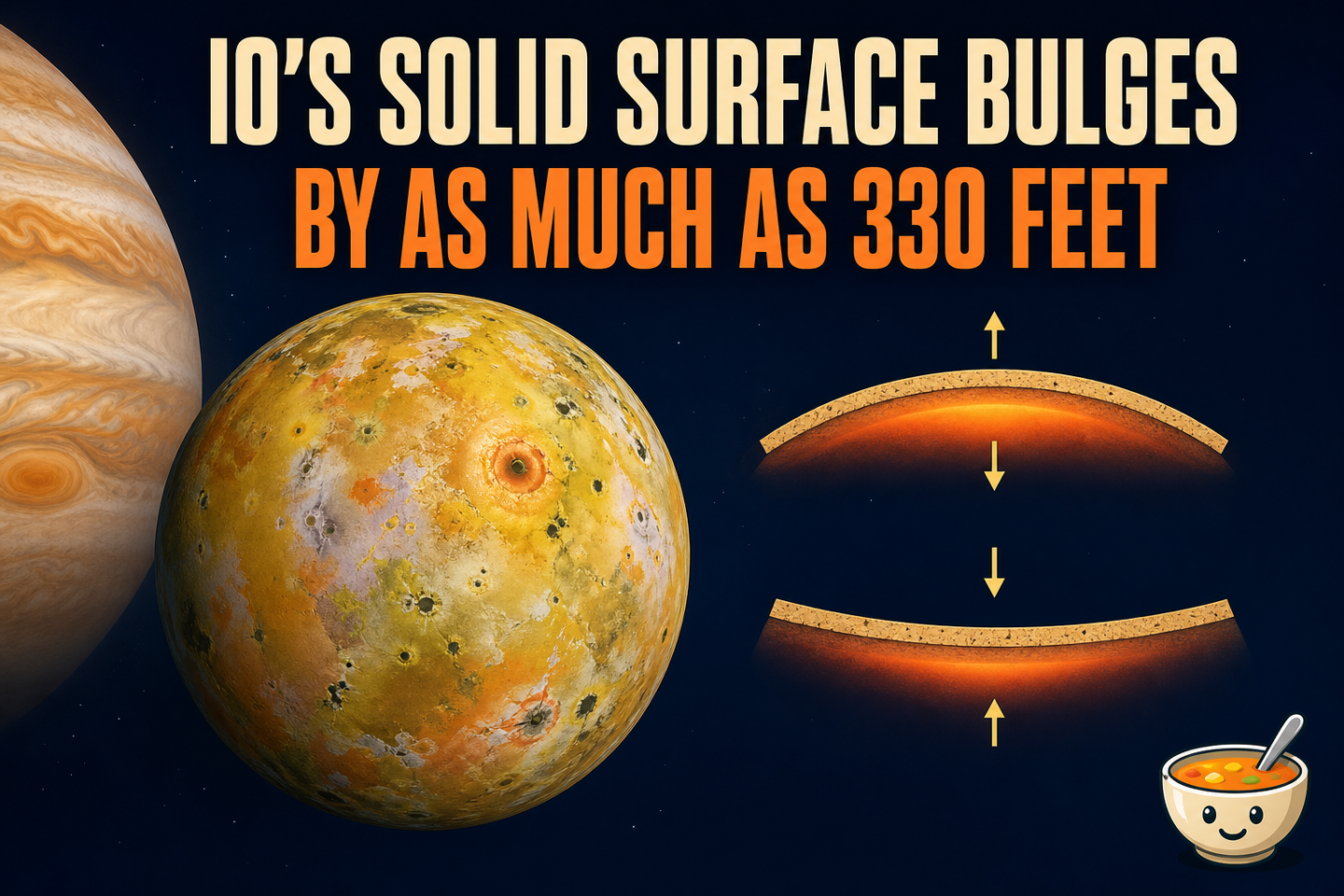
Earth’s tides make many people picture ocean water moving along a shoreline. Io shows that tides can also deform rock. NASA says Io’s solid surface can bulge up and down, or in and out, by as much as 330 feet (100 meters).
For scale, NASA compares that movement with the greatest difference between low and high ocean tides on Earth, about 60 feet (18 meters). Earth’s figure describes water. Io’s much larger figure describes solid ground. It is not a rigid shell remaining perfectly still beneath Jupiter; the moon is repeatedly squeezed and stretched.
The 330-foot value is a maximum, not a claim that every point on Io moves that far at all times. It expresses the enormous scale that tidal forces can reach when a moon orbits close to a massive planet while other moons keep disturbing its orbit.
How flexing becomes tidal heating
Repeated deformation requires work. As material inside Io bends and shifts, some of that mechanical energy becomes heat through internal friction. NASA states that the tidal forces generate a tremendous amount of heat within Io. This heat keeps much of the subsurface crust in liquid form, creating molten material that seeks routes toward the surface.
That link explains why Io volcanoes are so persistent. The gravity-driven cycle does not merely crack an otherwise quiet surface. It continually supplies internal heat that can melt material and support eruptions. Lava fills impact craters, forms molten lakes, and spreads across the surface in broad floodplains of liquid rock.
A surface shaped by constant volcanism
NASA describes a world with hundreds of volcanoes and lava fountains that can reach dozens of miles, or kilometers, above the surface. Because eruptions repeatedly cover older terrain, Io’s surface is continually reshaped. Impact craters can be buried by lava, while smooth plains spread across areas that might otherwise preserve a much longer record of impacts.
The material is not fully understood. NASA notes that theories include molten sulfur and sulfur compounds, which could help explain Io’s varied colors, as well as silicate rock, which could better match some of the high apparent temperatures. The essential point is firmer than the exact composition: tidal forces generate internal heat, and molten material repeatedly reaches the surface.
Why Europa and Ganymede matter
Jupiter is the largest source of gravity in this system, but NASA’s explanation specifically includes Europa and Ganymede. Their timed pulls perturb Io’s orbit into an irregular ellipse. That orbital disturbance makes Io’s distance from Jupiter vary and exposes it to the tremendous tidal forces that flex the moon.
This is why tidal heating is a system-level process. Io’s activity cannot be understood by looking only at the moon’s size or composition. Its orbit, Jupiter’s mass, and the gravitational rhythm of neighboring moons all matter. The result is a rocky body whose interior is heated by motion through a complex gravitational environment.
A volcanic world powered by gravity
Io’s volcanoes provide a vivid lesson in how orbital mechanics can shape geology. Repeated gravitational flexing is a dominant source of the energy driving Io’s surface activity.
The sequence is straightforward even if the system is extreme: Europa and Ganymede disturb Io’s orbit, its changing distance from Jupiter produces powerful tides, the solid moon flexes, and internal friction generates heat. That tidal heating keeps molten material moving and makes Jupiter’s moon Io the solar system’s most volcanically active world.