
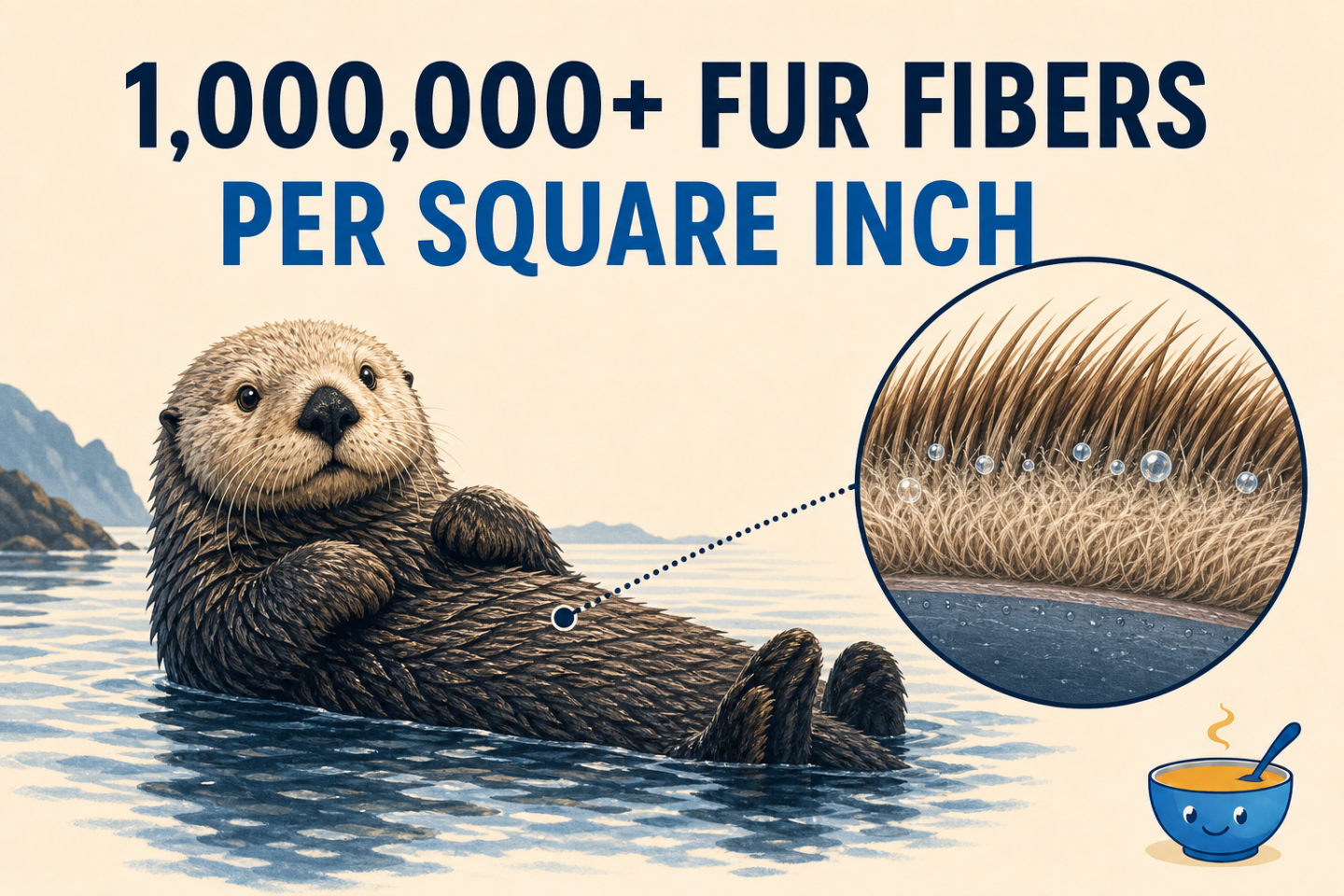
Sea otters enter cold coastal water without the thick blubber used by other marine mammals. Their alternative is an exceptionally dense coat: NOAA Ocean Today says sea otters have more than one million fur fibers per square inch. But the number is only the beginning. The coat works as a maintained, two-layer system that keeps a dry, air-filled region close to the body.
That distinction explains why sea otter fur is more than a warm-looking surface. Its structure, the way the hairs lie, and the animal’s grooming all matter. Remove any one of those ideas and the famous million-fiber fact becomes impressive but incomplete.
More than one million fibers in a square inch
The statistic describes density within a unit of area, not the total number of hairs on an otter. NOAA’s transcript says the coat contains more than one million fibers per square inch. Packing so many fibers into such a small area creates a dense barrier, but our illustration does not attempt to draw or count them individually. The magnified fur sample is symbolic, designed to make the two layers readable on a phone screen.
This is also why the wording should stay precise. The source says more than one million fibers per square inch; it does not provide a single exact count for an entire animal. The useful fact is the extraordinary local density.
Two layers do different jobs
NOAA describes longer outer guard hairs and another layer beneath them. The guard hairs are about 1 1/3 inches long and, when properly groomed, lie flat against the body. Under those hairs is an inner layer that stays completely dry.
Saying that the inner layer stays dry does not mean every visible hair remains dry while the otter floats. The outer surface meets the water. The important protected region is deeper in the coat, where the dense fibers and their arrangement help keep water from replacing the air next to the body.
The insulation system includes air
Air trapped in sea otter fur is not merely a visual curiosity. NOAA identifies that air, together with the otter’s relatively large lung capacity, as a reason for the animal’s buoyancy. The same dry, air-holding coat is the insulation system that allows a sea otter to maintain its body temperature without blubber.
Why grooming is essential
The phrase “properly groomed” is easy to overlook, yet it connects the anatomy to the behavior. NOAA notes that properly groomed guard hairs lie flat. Grooming therefore is not cosmetic decoration added to the insulation story; it is part of keeping the physical arrangement described by the source.
That makes the sea otter’s coat a useful example of a biological system rather than a single superlative. The million-fiber density attracts attention, but the real payoff is cooperation: two layers, trapped air, and continuous maintenance allow fur to perform a job that blubber performs in many other marine mammals.
A living coat, not just a big number
The memorable number is real, but it matters because of what those fibers do together. A sea otter does not simply own an unusually hairy coat. It maintains a carefully arranged boundary between cold water and a dry inner layer. That is how one square inch of fur becomes part of a whole-body survival system.