
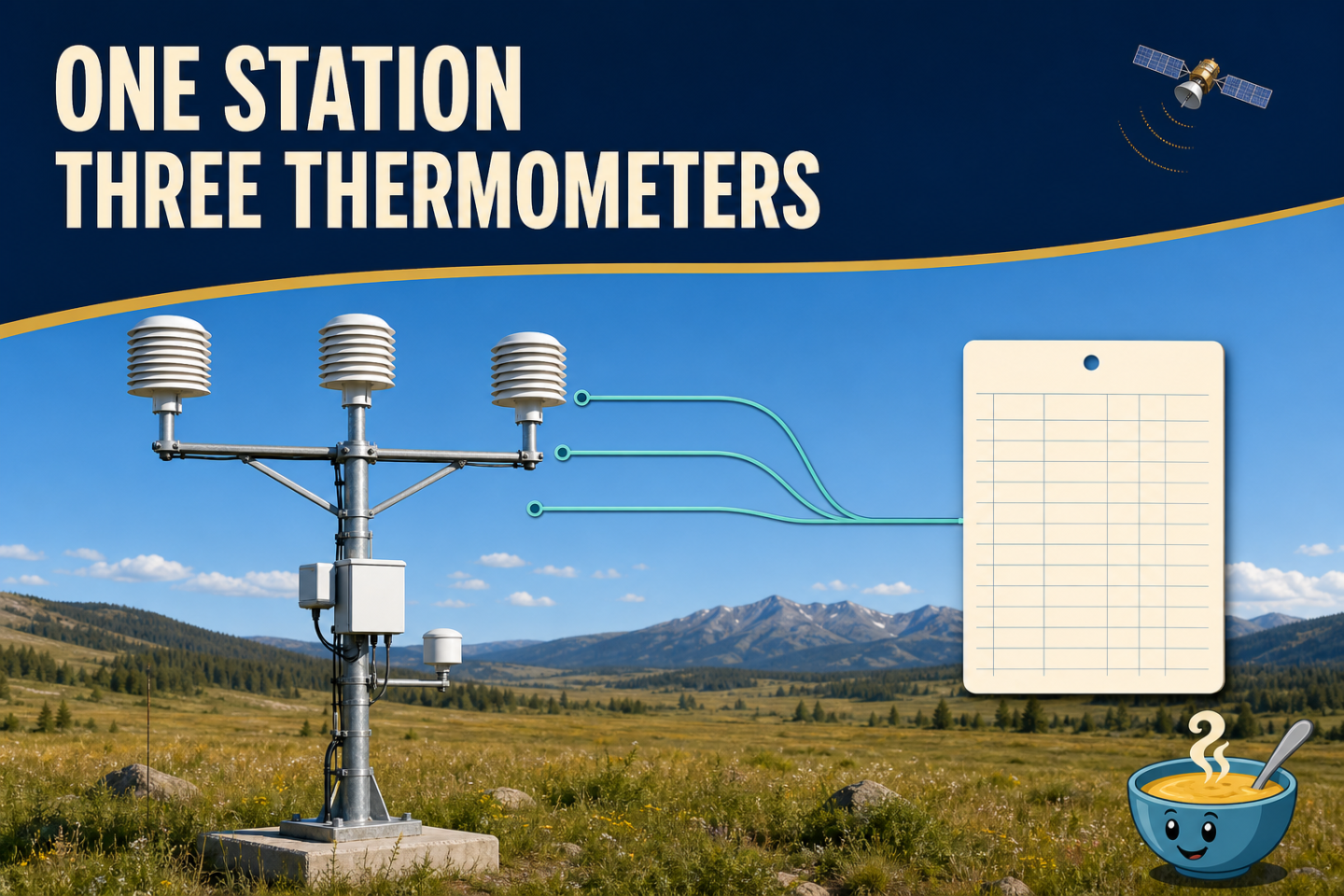
Why would one climate station need three thermometers? A station in NOAA’s U.S. Climate Reference Network does not place its official hourly temperature on the word of one sensor. It uses three independent thermometers, preserves their observations as separate streams, and derives one official value only after the data reach the National Centers for Environmental Information, or NCEI.
That design creates evidence that can be compared. It also explains why “three thermometers” does not mean “add three numbers and always divide by three.” NOAA’s method can produce a median or an average of different agreeing combinations, depending on how the instruments compare.
The evidence starts as three separate streams
Each station carries three platinum resistance thermometers. Every thermometer sits in its own fan-aspirated solar shield and measures air temperature independently. NOAA describes the multiple sensors as a source of redundancy and independent validation rather than three parts of a single sensor.
Keeping the streams separate matters. If all three thermometers were blended at the first step, their agreement or disagreement would be harder to inspect later. Instead, the station’s datalogger handles each instrument on its own track.
Two-second readings become five-minute evidence
Each thermometer measures temperature every two seconds. Every five minutes, the datalogger averages the readings from that thermometer to create an independent five-minute value. One five-minute average therefore represents 150 two-second readings: 300 seconds divided by two. Over an hour, the process produces 12 five-minute averages for each thermometer. The datalogger also calculates a standard deviation for each instrument.
This is the first compression step in the evidence trail. Many rapid readings become a manageable series, but the identity of each thermometer remains intact. NOAA can still compare one instrument’s observations with the other two.
One official value is not always one simple average
The station transmits its three independent observed temperature values. The official hourly computation happens after those values arrive at NCEI. NOAA compares the instruments in pairs using an agreement threshold of 0.3°C.
The resulting official value is sometimes the median of the three observations and sometimes an average of different combinations, depending on which instruments agree in those pairwise comparisons. That qualification is important: a diagram showing three lines converging on one record is a useful summary, but it should not imply that the system blindly averages every available number in every case.
The trip from field station to climate record
Each station sends data hourly through a geostationary satellite. The satellite is the communications link, not the thermometer and not the judge of the observations. NCEI receives the values, performs the official computation and quality-control work, and makes raw data and summary statistics available through the network’s website.
Redundancy is only one layer of the system. NOAA says instruments are calibrated or verified annually, aging sensors are routinely replaced, and station performance is monitored daily. Those practices do not make any single reading infallible. They create multiple chances to detect, compare, and address problems.
Why the three-thermometer design matters
A published hourly temperature can look like a single, effortless number. At a reference station, however, that number is the end of a visible chain: three independent instruments, repeated sampling, separate five-minute averages, an hourly transmission, pairwise comparison, and a documented decision rule.
The memorable fact is not merely that one station has extra thermometers. It is that the network treats measurement as an evidence trail. The official value becomes more understandable because the observations behind it remain available for comparison instead of disappearing inside one sensor.