
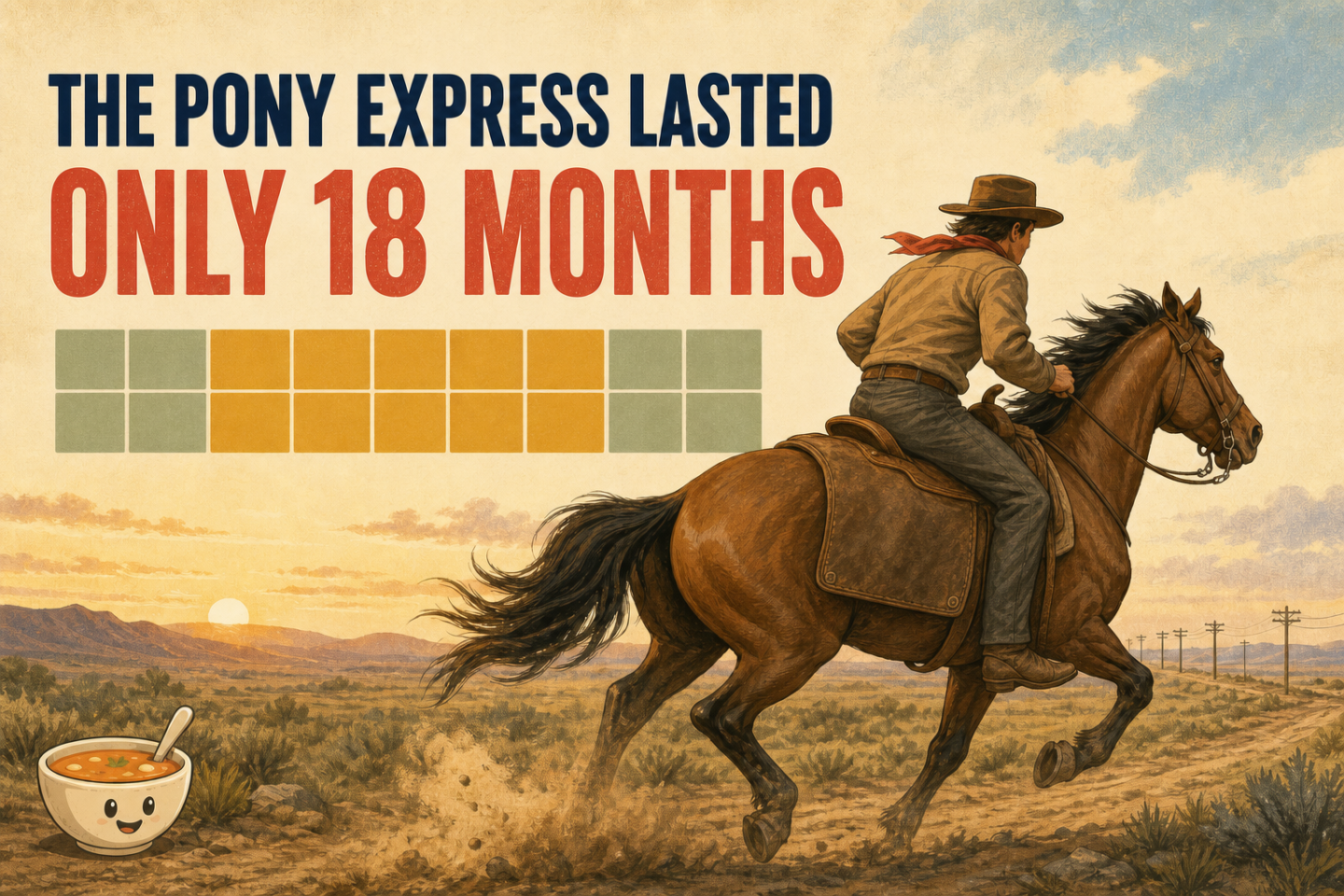
The Pony Express feels as if it belonged to an entire age of the American West. In reality, the service operated for only 18 months, from April 1860 to October 1861. Its working life was shorter than the legend it created.
During that brief span, riders carried mail more than 1,800 miles from St. Joseph, Missouri, to Sacramento, California, in about ten days. The achievement came from a carefully organized relay system, not from one rider or horse crossing the continent alone.
A communication problem beyond the Rockies
Fast long-distance communication was becoming increasingly important in the mid-1800s. The National Park Service connects that demand to westward movement following the California Gold Rush, the Mormon migration to Utah, and travel along the Oregon Trail. Existing overland mail services helped, but the need for faster service remained.
William H. Russell, Alexander Majors, and William B. Waddell organized the operation that became known as the Pony Express. According to the National Park Service, the team had only about two months to prepare before the first official delivery. They needed more than 100 stations, 400 to 500 horses, and enough riders to keep mail moving.
Speed came from constant handoffs
The Pony Express worked more like a moving chain than a heroic solo ride. Fresh horses were provided every 10 to 15 miles, and fresh riders every 75 to 100 miles. The first-ride account says about 75 horses were required for a one-way trip, with an average speed of roughly 10 miles per hour.
As the network developed, it used more than 190 stations. At relay stations, a rider exchanged a tired horse for a fresh one. At home stations, riders could rest between their longer shifts. A rider typically covered about 75 to 100 miles and changed horses several times. The National Park Service says only two minutes were allotted for exchanging the horse and the mochila, the leather cover that carried the mail.
That structure explains how mail could keep traveling day and night. The famous rider mattered, but so did the station keepers, stock tenders, horses, and the chain of places that made the next handoff possible.
The first run made the idea real
The first official eastbound departure began in St. Joseph on April 3, 1860. A mail pouch containing 49 letters, five telegrams, and other papers was handed to a rider. The pouch reached Salt Lake City on April 9, Carson City on April 12, and San Francisco around midnight on April 14.
The trip demonstrated what the relay could do, but it also revealed the scale of the undertaking. Maintaining stations, people, and hundreds of horses across difficult terrain was expensive and complicated. The Pony Express was a functioning service, yet it was also racing against a different communications technology.
The wires were advancing at the same time
Congress authorized support for a transcontinental telegraph line on June 16, 1860, only about ten weeks after Pony Express operations began. As telegraph lines advanced from opposite directions, the Pony Express still carried letters and newspapers across the full route. Telegrams, however, could travel between the growing ends of the wire.
On October 26, 1861, San Francisco gained direct telegraph contact with New York City. The Pony Express officially terminated that same day. The last letters still completed their journeys afterward, but the new wire connection had changed the purpose of rapid overland communication.
Why the short life is the memorable part
The Pony Express did not last long enough to define a generation of mail service. What it compressed into those 18 months was unusually vivid: a continental route, a relay network, frequent horse changes, and a race against the arrival of near-instant electronic communication.
Even the physical trail is not perfectly fixed in the present. The National Park Service notes that much of the original route has been altered or erased, and that parts of its exact path and length remain matters of historical reconstruction. The legend is clearer than some sections of the trail itself.
That contrast is the lasting lesson. The Pony Express is remembered not because it operated for decades, but because it occupied a narrow bridge between slow overland mail and the telegraph—and crossed that bridge at full speed.