
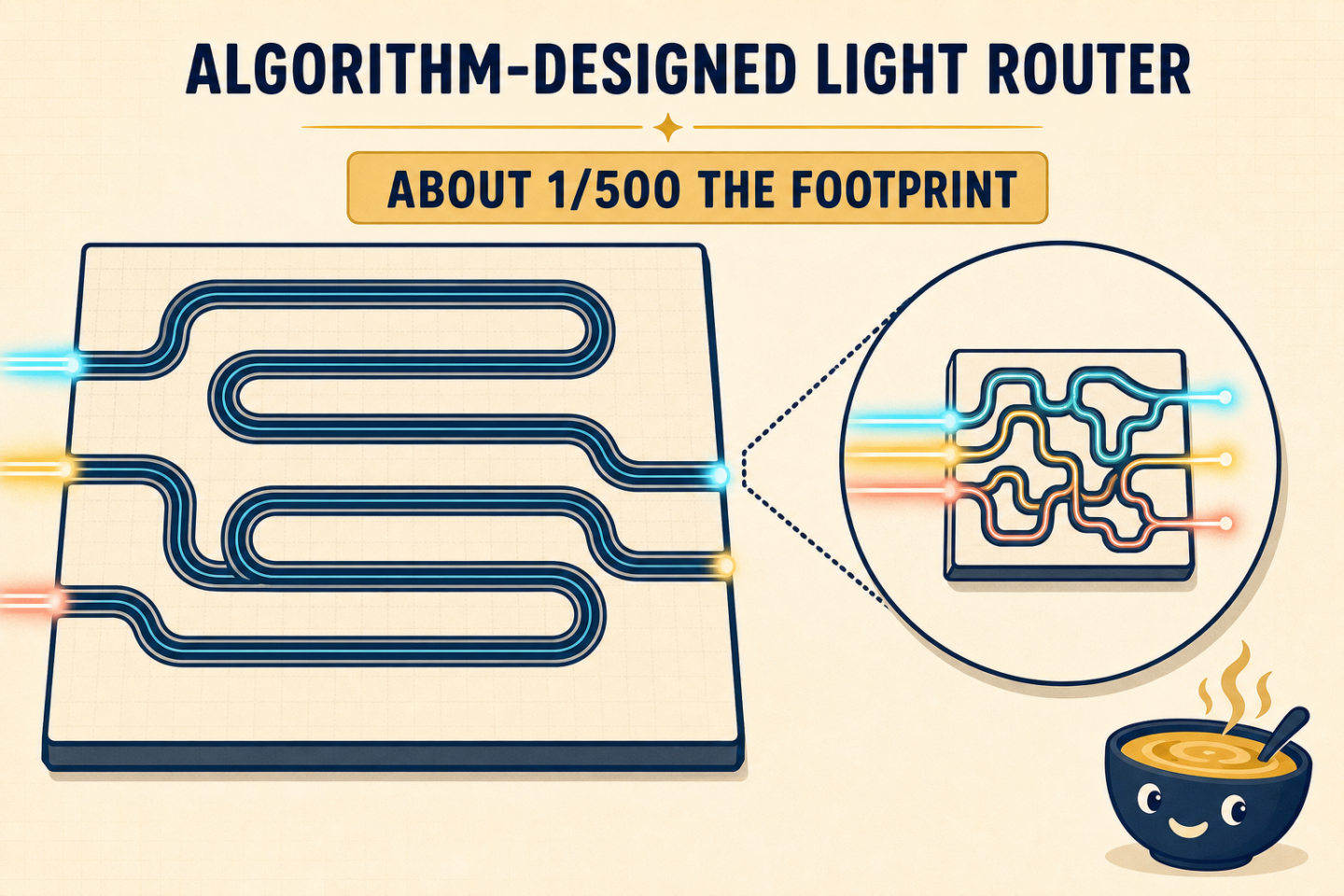
A photonic circuit guides light through paths on a chip. The usual design process begins with familiar building blocks, arranges them, and then checks whether the result performs the intended job. Inverse design turns that logic around: engineers define what the light should do at the outputs, and an optimization algorithm searches for a structure that can make it happen.
That goal-first approach can produce shapes that look less like a tidy human diagram and more like a compact maze. In a peer-reviewed study of silicon-nitride photonics, one inverse-designed mode-division multiplexer occupied roughly one five-hundredth the footprint of representative conventional implementations.
What is being sorted?
Light traveling through a waveguide can occupy different spatial modes. A mode-division multiplexer, or MDM, separates those modes into different output paths. It is a light sorter: the input contains distinct patterns of electromagnetic energy, and the component directs them where they need to go.
Conventional versions often use couplers or other structures that need a relatively long interaction distance. The study compared those representative implementations with inverse-designed MDMs measuring 8 by 8 micrometers and 15 by 10 micrometers. The reported footprint reduction was on the order of 500 times.
That number is carefully bounded. It describes the area occupied by the demonstrated MDMs relative to representative conventional designs cited by the researchers. It does not mean that every photonic circuit, computer chip, or device can automatically be made 500 times smaller.
Designing from the result backward
The process begins with constraints. The material, the available design area, the incoming light, the required outputs, and fabrication limits are specified. A computer model predicts how light would move through a candidate structure. An optimization method then adjusts the geometry, tests the new result, and repeats the cycle.
Instead of asking a human to draw every curve, the system asks a more direct question: which pattern inside this small region best approaches the desired optical behavior? The final geometry may be difficult to invent by intuition alone, but it still has to obey physics and be manufacturable.
The researchers used this approach on a thick silicon-nitride platform. Silicon nitride is valuable in many optical systems because it can guide light with low loss, but its lower refractive-index contrast can make compact components harder to design. The experiment therefore tested whether inverse design could create small, functional devices on a platform where space is especially valuable.
One method, several optical jobs
The team did not demonstrate only one structure. The paper reports inverse-designed wavelength-division multiplexers, mode-division multiplexers, and reflectors used to form optical resonators. The wavelength sorters occupied footprints from 5 by 5 to 8 by 8 micrometers, with reported reductions of roughly 50 to 300 times relative to representative conventional implementations.
The MDM comparison was the most dramatic: footprints from 8 by 8 to 15 by 10 micrometers and a reduction on the order of 500 times. The researchers also fabricated the devices and measured their optical performance, so the result was not limited to a computer-generated pattern.
Why a strange shape can be useful
Human-designed components often favor symmetry, repeated sections, and shapes whose behavior is easy to reason through. Those qualities remain valuable, but they can narrow the search. An optimization algorithm can explore irregular geometries while repeatedly checking the same performance target.
The lesson is not that algorithms understand light better than physicists. People still choose the goal, model, material, constraints, manufacturing process, and tests. The algorithm expands the set of candidate shapes that can be considered within those decisions.
The important part is the boundary
“About 500 times smaller” is memorable, but the boundary makes it meaningful. It refers to footprint, not every dimension or performance measure. It applies to the study’s mode sorter and its stated comparison set. Other devices in the same paper had different reductions.
Within that boundary, the result reveals a powerful design idea: when space is scarce and the desired behavior is clear, it can be productive to begin with the destination of the light and search backward for the path.