
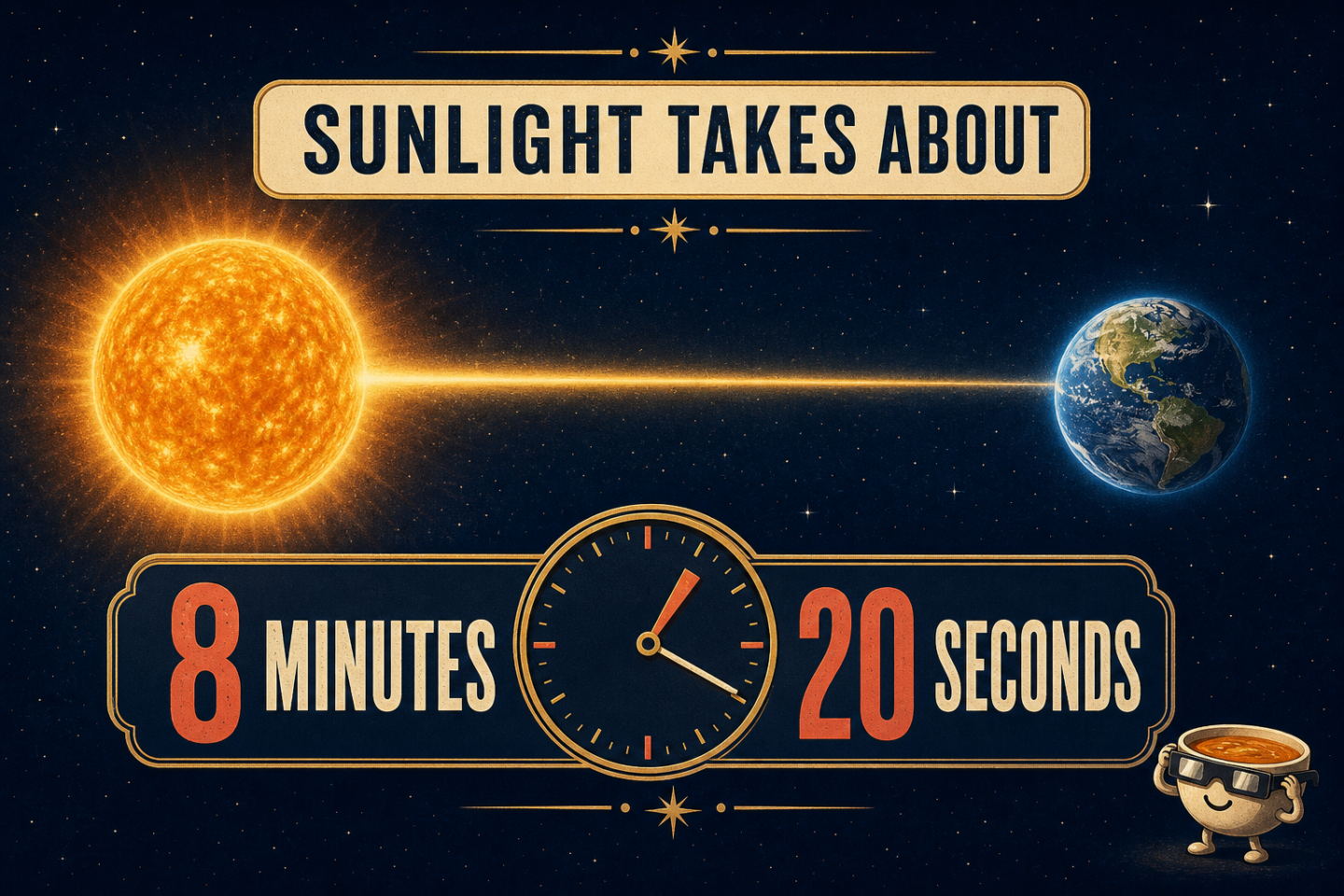
The sunlight reaching your face did not leave the Sun this instant. It began its journey about 8 minutes and 20 seconds earlier. That short delay means every ordinary view of the Sun is also a view into the recent past.
The reason is distance. NASA Space Place gives the average Sun–Earth separation as approximately 93 million miles. Light crosses that enormous gap faster than anything else can, but the journey is not instantaneous.
Quick facts
- The Sun is approximately 93 million miles from Earth.
- Sunlight takes about 8 minutes and 20 seconds to reach us.
- The Sun we see is therefore the Sun as its arriving light left it more than eight minutes earlier.
Distance becomes time
We often treat seeing as immediate. Across a room, the delay is far too small to notice. Space changes the scale. The gap between the Sun and Earth is so large that even light needs several minutes to cross it.
That gives distance an unusual consequence: it becomes a delay in information. A change at the Sun cannot appear in Earth’s sky until light carrying that new view has completed the trip. Nothing about the sunlight pauses along the way; the path itself simply takes time to cross.
What “seeing the past” actually means
The phrase can sound more dramatic than the physics. We are not watching a recording stored somewhere in space. We are receiving light now, but that light carries information about the Sun when it began the journey.
The same logic applies whenever we observe a distant object. Greater distance creates a longer lookback time. For our nearby star, the delay is measured in minutes. The principle is enough to make the daytime sky feel different: even the most familiar object in it is never shown to us in perfect real time.
The number is approximate for a reason
The familiar 8-minute-20-second figure is a useful rounded value tied to the approximate Sun–Earth distance. It should not be read as a claim that every ray always follows an identical path from a perfectly fixed distance. For everyday explanation, however, it captures the scale accurately: sunlight spends more than eight minutes traveling before it reaches Earth.
A delayed sunrise
When the Sun appears over the horizon, the light forming that view has already crossed millions of miles. The sunrise feels immediate because the final event happens in your sky, yet the information reaching your eyes began far away and several minutes earlier.
That is the quiet surprise hidden in daylight. The Sun is close enough to warm our planet and dominate our sky, but distant enough that its present appearance always arrives late.