
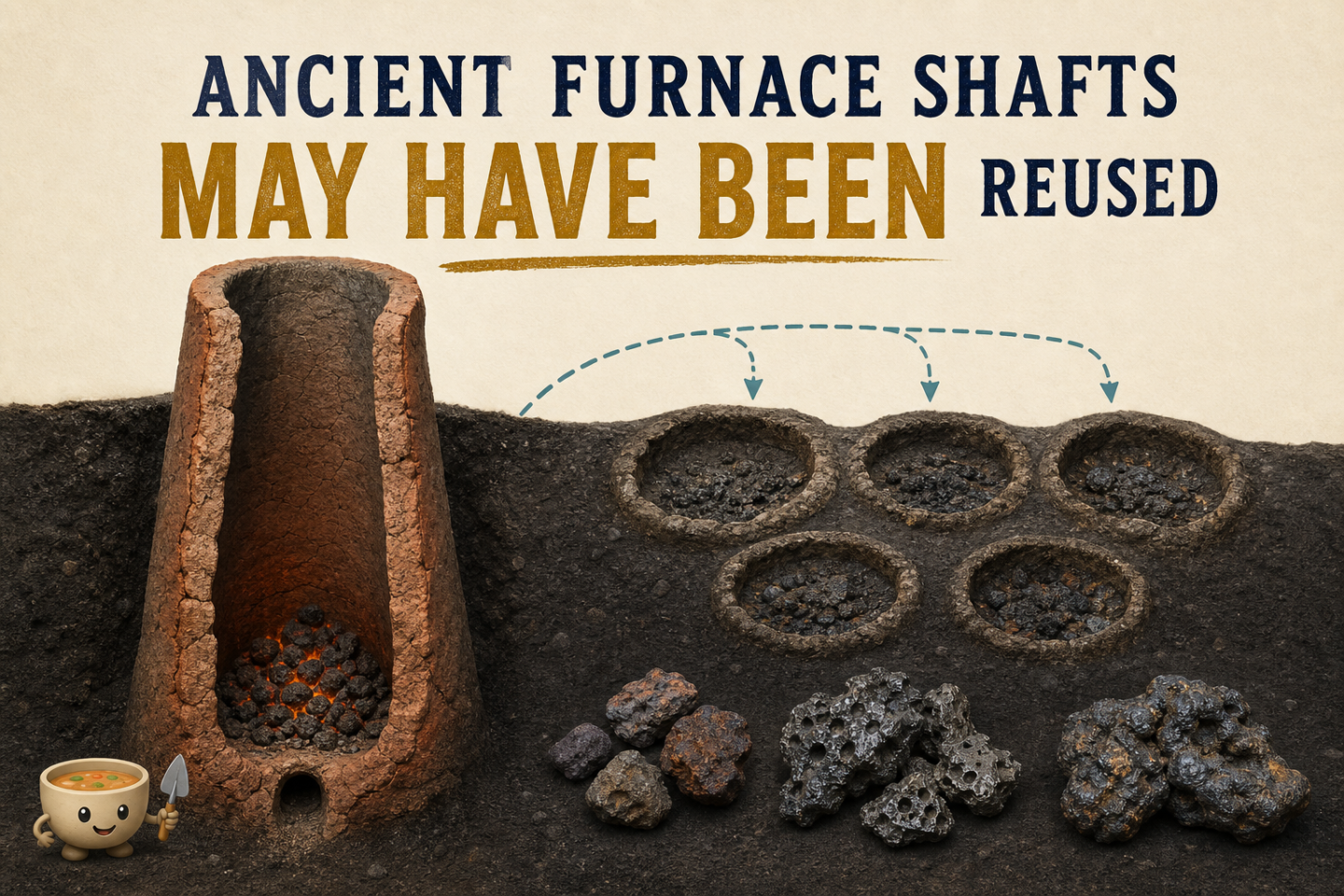
Ancient ironworkers left no operating manuals beside their furnaces. What survives instead is a material puzzle: scorched clay, slag, ore fragments, and the positions of structures in the ground. At four early Roman Imperial-period sites in the northern Harz foothills, those clues led researchers to a careful interpretation. Some bloomery furnace shafts may have been reused for more than one smelt.
The conclusion does not come from one spectacular object. It comes from a pattern assembled across furnace remains, waste material, and ore chemistry. That makes the case a useful example of how archaeology reconstructs a vanished technology without pretending that every detail is certain.
Quick facts
- The study examined four iron-smelting sites in the northern Harz foothills.
- The sites date to the early Roman Imperial period, a chronological label that does not mean the furnaces belonged to the Roman state.
- Grouped bloomery remains led the authors to infer that some furnace shafts may have been used multiple times.
- Dark manganese-rich ore was identified geochemically at three sites and found as archaeological fragments at the fourth.
What a bloomery furnace left behind
A bloomery was designed to turn iron ore into a workable mass of iron without fully melting the metal. In the setup described by the researchers, roasted ore and charcoal were placed in alternating layers inside a shaft. Air entered through tuyères, probably driven by bellows, while molten waste material collected in a slag pit below.
The finished iron left the site, but much of the waste did not. Slag, damaged furnace walls, and lower structural remains could stay in the ground for centuries. Archaeologists can therefore examine both the physical arrangement of a smelting area and the chemical signatures of the materials found there.
The clue hidden in grouped remains
The four sites did not preserve a simple row of complete furnaces waiting to be counted. They preserved clusters of bloomery remains. The authors interpreted this grouping as evidence consistent with multiple use of furnace shafts.
Why would grouping matter? A shaft reused above more than one smelting episode can leave a different archaeological pattern from a workflow in which workers built an entirely new shaft for every firing. Repeated arrangements across several sites make the reuse interpretation more persuasive than an isolated feature would be.
Even so, the word may is essential. The ground preserves the aftermath, not the action. Grouped remains support an explanation; they do not provide an eyewitness record of how many times any particular shaft operated.
Ore and slag as material fingerprints
Layout was only one part of the investigation. The researchers also analyzed slag and ore. They identified a dark, manganese-rich ore geochemically at three of the sites, while archaeological ore fragments linked the fourth site to the same general material tradition.
That evidence helps connect the furnaces to the raw materials processed in them. Slag is especially valuable because it is the residue of the smelting process itself. Its composition and structure can preserve information about ore, fuel, temperature, and operating choices even after the iron product has disappeared.
Why the cautious wording matters
Archaeological reconstruction works by comparing independent clues. A grouped layout can suggest a repeated workflow. Ore can reveal what entered the furnace. Slag can record parts of the transformation. When those lines agree, they narrow the range of plausible explanations.
They do not eliminate every alternative. The researchers note that questions remain about how this smelting knowledge developed and moved through the region. Future investigations may refine the reuse interpretation or distinguish different practices among the sites.
A technology reconstructed from leftovers
The striking part of the story is not that archaeology can make the past perfectly visible. It is that ordinary leftovers can make a careful argument possible. A slag pit, a patch of fired clay, and a chemically distinctive ore fragment may look unimpressive alone. Together, their position and composition can reveal how skilled workers organized repeated, demanding acts of production.
That is why the ancient furnace shaft is best described as something that may have been reused. The claim is modest, but the reasoning behind it is rich: technology survives not only in finished tools, but also in the patterns left by making them.