
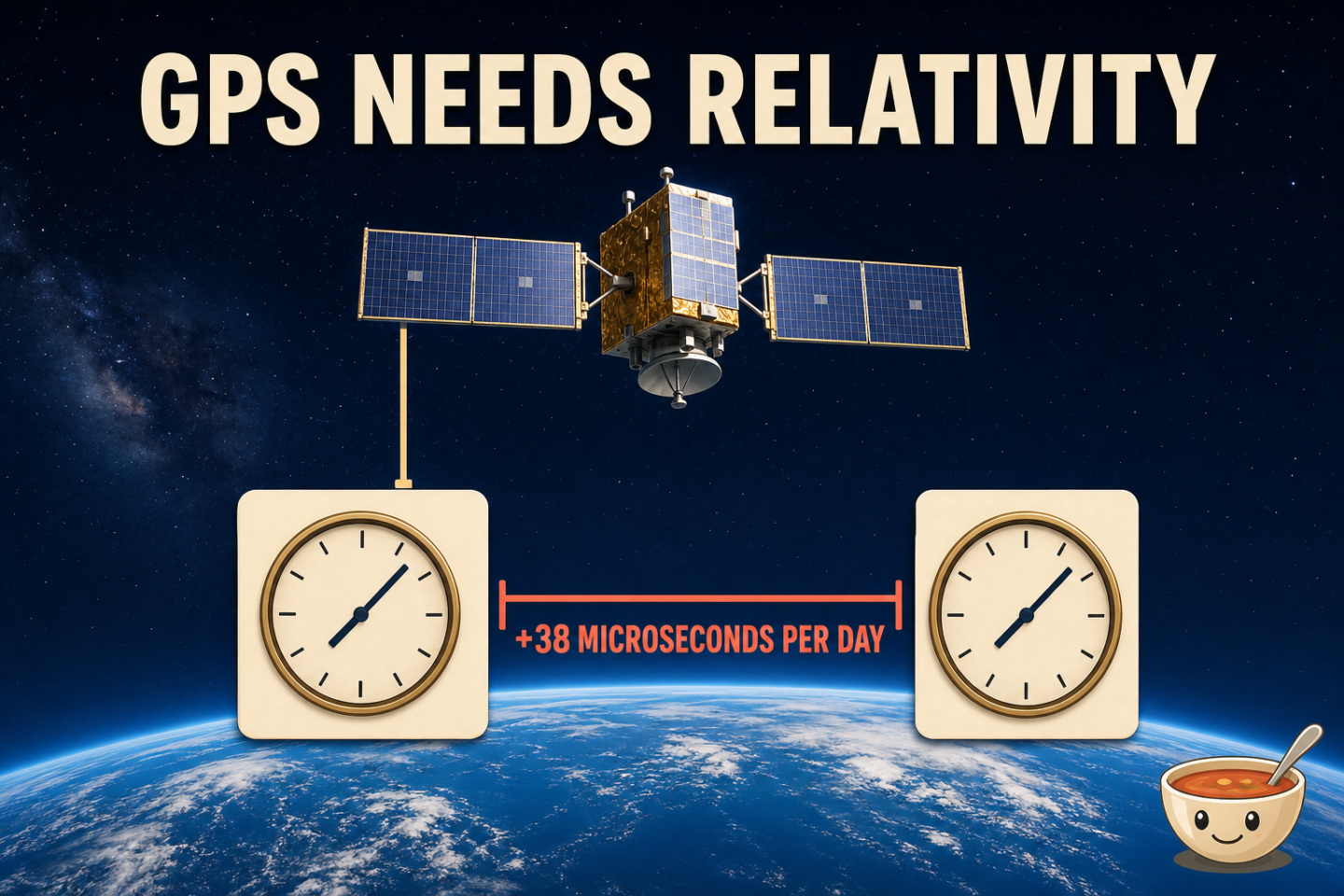
GPS does not work by treating every clock as if it ticks at the same rate. The atomic clocks aboard its satellites are moving quickly and orbiting where gravity is weaker than it is on Earth’s surface. Both conditions change how those clocks compare with clocks on the ground.
The two changes point in opposite directions. According to the National Institute of Standards and Technology (NIST), motion makes a GPS satellite clock fall behind an Earth clock by about 7 microseconds per day. Weaker gravity makes it run ahead by about 45 microseconds per day. Combine them and the satellite clock ends up about 38 microseconds per day faster before the system accounts for relativity.
Two versions of relativity pull the clock in opposite directions
Special relativity describes the effect of motion on time. A GPS satellite moves rapidly relative to someone standing on Earth, so its onboard clock ticks a little more slowly by that comparison. The difference is tiny: NIST gives the daily effect as minus 7 microseconds. A microsecond is one millionth of a second.
General relativity adds the effect of gravity. Time passes more slowly where gravity is stronger and more quickly where gravity is weaker. GPS satellites orbit in weaker gravity than clocks on Earth’s surface, so this effect pushes their clocks in the faster direction. NIST gives that contribution as plus 45 microseconds per day.
The larger gravity effect wins. The arithmetic is straightforward: plus 45 microseconds from weaker gravity, minus 7 from motion, leaves a net plus 38 microseconds per day. That is what the image’s comparison represents. It is the uncorrected difference, not an error that modern GPS simply allows to accumulate.
Atomic clocks made these differences measurable. NIST notes that researchers have compared clocks on airplanes, satellites, and skyscrapers with clocks on the ground, repeatedly confirming the predicted effects of motion and gravity.
Why such a small difference matters
Positioning satellites are clocks as much as they are objects in the sky. GPS depends on precise timing, so a systematic difference between satellite time and Earth time cannot be treated as harmless. Even though 38 microseconds is far shorter than a blink, it repeats day after day unless it is accounted for.
This is why the practical lesson is not that GPS clocks are defective. They are behaving exactly as relativity predicts. The engineering task is to build that predictable behavior into the timing system so the signals provide accurate time on Earth.
Correction is part of the design
NIST explains that the scientists and engineers who launched the positioning satellites recognized the need to correct for relativistic effects. That distinction matters. GPS does not discover a fresh 38-microsecond surprise every morning and repair it afterward. Relativity is part of the model used to make satellite timing useful.
The correction also combines both effects. Saying only that speed slows clocks would miss the larger gravitational contribution. Saying only that clocks run faster in weaker gravity would ignore the opposing motion effect. The useful number comes from keeping both pieces in view.
A physics experiment running above us
GPS was built for positioning, not as a laboratory demonstration of Einstein’s theories. Yet every satellite carries an atomic clock, and those clocks operate under conditions where relativistic effects matter. NIST notes that, because the system has worked for so long, GPS can be seen as an exceptionally long-running test of relativity.
That makes the blue location dot on a phone more surprising than it looks. Behind an ordinary navigation result is a technology that must respect how motion, gravity, and time fit together. Relativity is not only an idea for black holes or near-light-speed journeys. It is part of the timing infrastructure circling Earth right now.
The memorable part
The striking fact is not merely that GPS needs accurate clocks. It is that two invisible effects almost cancel, but not quite. Speed subtracts 7 microseconds, weaker gravity adds 45, and the remaining 38 must be handled deliberately. A difference measured in millionths of a second becomes a design requirement for a system used to find places on Earth.