
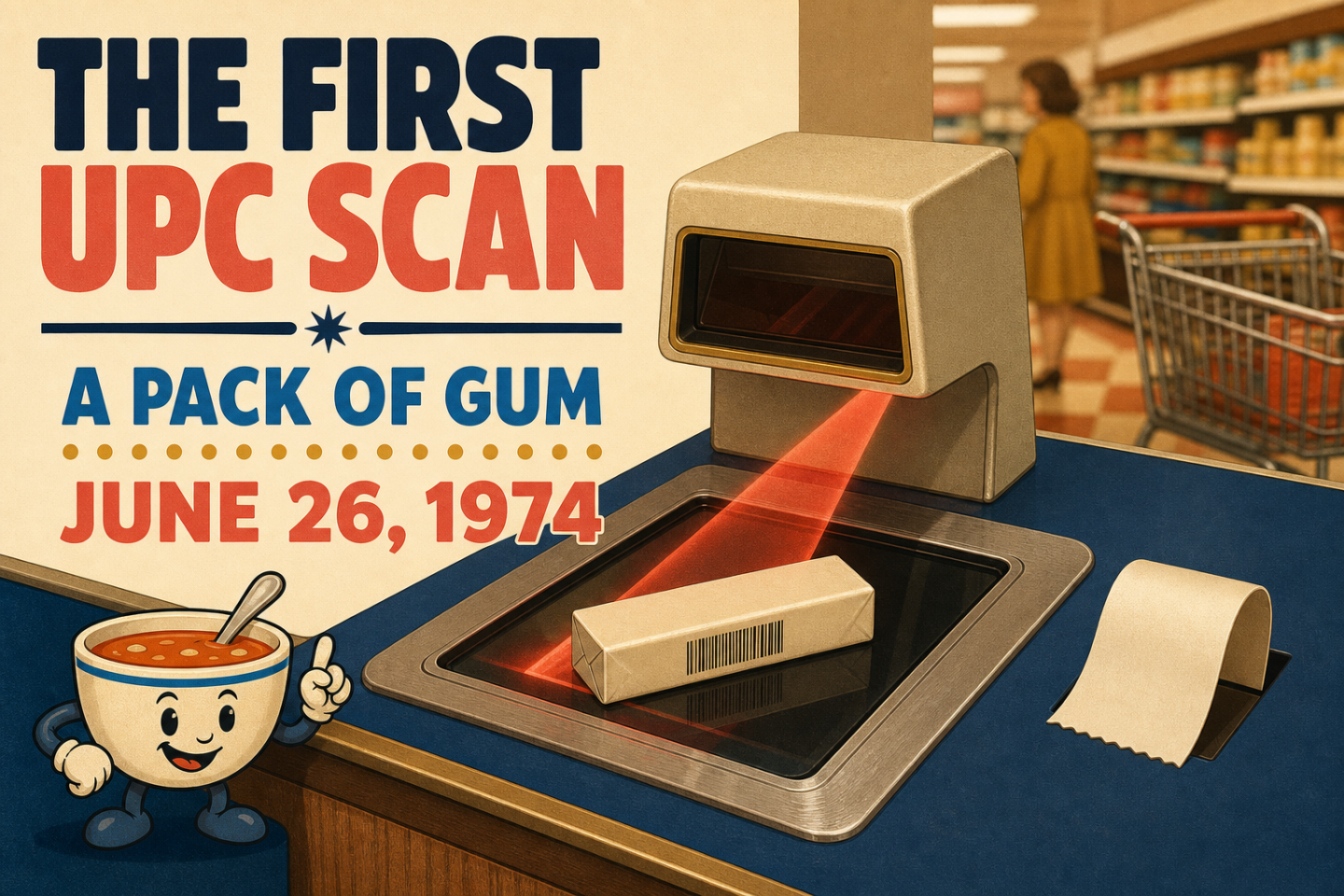
On the morning of June 26, 1974, a shopper brought an ordinary pack of Wrigley’s chewing gum to a checkout in Troy, Ohio. What happened next looked simple: the cashier passed the package over a scanner and the register identified it. Yet this small transaction was the first purchase made with a scanner capable of reading the new Universal Product Code, or UPC.
The setting was a Marsh supermarket, and the purchase became a milestone because it showed that a standardized product code could work in a real store. The familiar checkout beep that now feels almost invisible was once the sound of a new retail system proving itself.
Why a pack of gum made history
The gum itself was not technologically special. Its importance came from being the first item used in a completed UPC checkout transaction. That ordinariness is part of what makes the story memorable. A system designed to identify millions of everyday products began with something small enough to fit in a pocket.
The Smithsonian’s National Museum of American History records that the installation in Troy included ten early supermarket scanners. One of those scanners survives in the museum’s collection. The original gum package, however, did not enter the Smithsonian collection. The historical object is the scanning equipment that helped turn the printed code into usable information.
What the scanner actually did
A UPC barcode is not simply a price printed in machine-readable form. The striped symbol represents a product identifier. When the scanner reads that pattern, the store’s computer uses the identifier to find information associated with the product in a database. That information can include the description and the current price.
The early scanner documented by the Smithsonian used a helium-neon laser. A rotating mirror directed the beam through a glass plate in the checkout surface. Light reflected from the barcode back to a detector, which converted the pattern into a signal. The computerized cash register then matched that signal with a stored product record.
This separation between identifier and database matters. A store could change a price in its computer system without printing a completely new machine-readable price on every package. The same identification approach also helped retailers keep more consistent records of what was sold.
A standard mattered more than a single machine
The checkout scanner was only one part of the achievement. For the system to work across many manufacturers and retailers, everyone needed a common way to identify products. Grocery-industry leaders organized an effort to create that shared coding system in the early 1970s. The result was the UPC: a standardized number represented by a barcode that compatible equipment could read.
Without that agreement, each retailer or manufacturer might have used a different format. Stores would have needed incompatible equipment or costly translation systems. A common standard allowed packaging, scanners, registers, and databases to cooperate. The important innovation was therefore not just the striped symbol or the laser. It was the combination of a shared identifier, reliable reading equipment, and connected product data.
How one beep changed retail work
Before automated scanning, checkout work depended heavily on price labels and manual key entry. A machine-readable identifier made it possible to retrieve product information quickly and consistently. It also created a digital record of each scanned item, supporting inventory tracking and sales analysis.
The change did not transform every store overnight. New equipment, compatible packaging, accurate databases, and staff procedures all had to spread together. But the Troy installation demonstrated that the full chain could function in an operating supermarket. That is why the first scan is remembered as more than a gadget demonstration: it was a working connection between a physical product and a digital information system.
The quiet legacy of the first UPC scan
Barcodes became so common that most shoppers barely notice them. They appear on groceries, books, shipping labels, medical supplies, and countless other objects. The technology has evolved, and newer two-dimensional codes can carry or connect to more information, but the underlying idea remains powerful: give an item a standardized identity that machines can read accurately.
The first UPC purchase captures that idea in one compact scene. A pack of gum crossed a glass plate, a laser read a pattern of bars, a computer found the matching record, and a register completed the sale. The event lasted only a moment. Its logic became part of everyday commerce.