
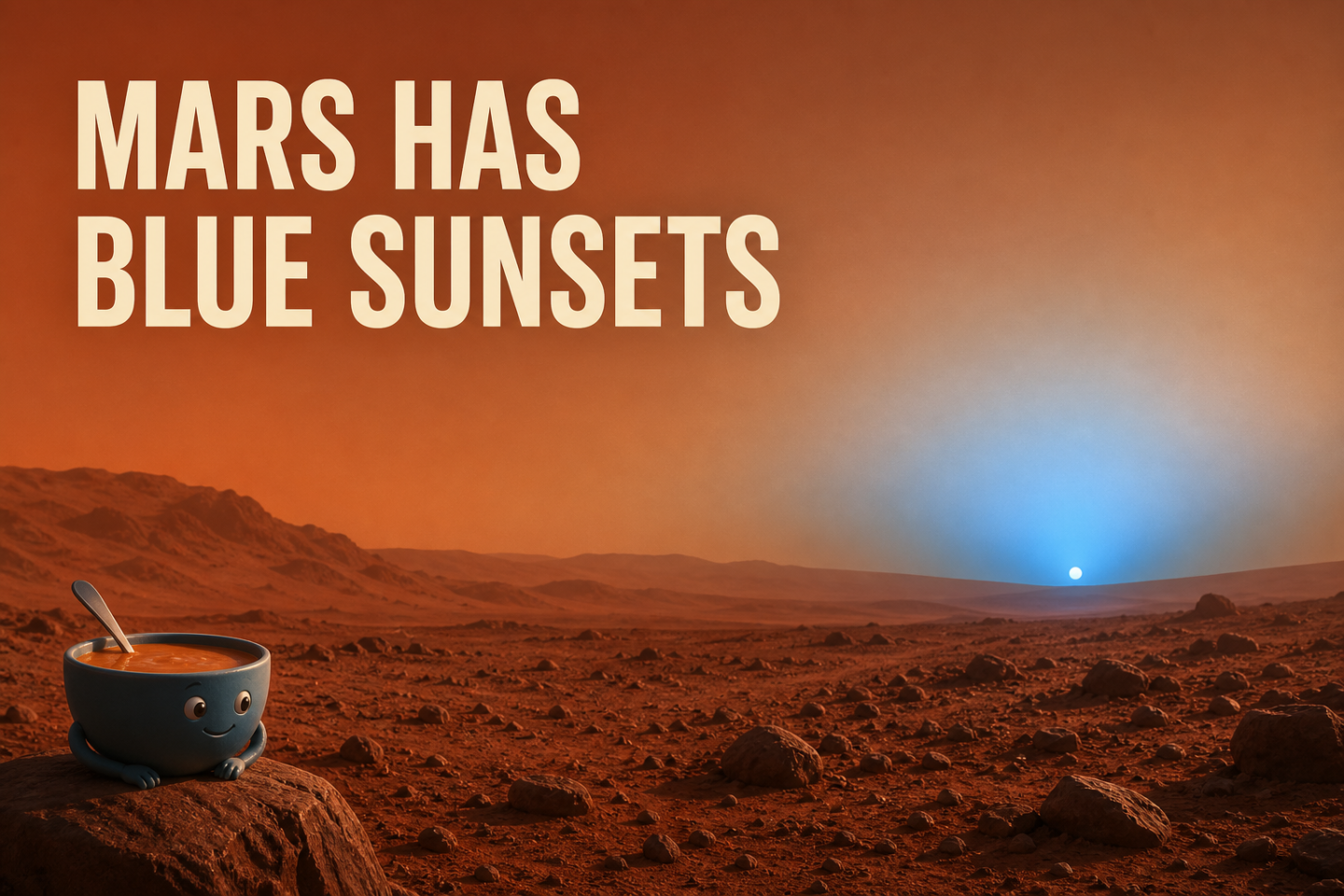
Mars is called the Red Planet, but stand on its surface at sunset and the most striking color may be blue. Images returned by robotic explorers show a cool blue glow surrounding the setting Sun, while much of the wider sky remains yellow, orange, or rusty red.
This is not a contradiction. The ground and the daytime atmosphere can still look reddish because of iron-rich dust. At twilight, however, the way sunlight travels through that fine dust makes blue light stand out close to the Sun.
A red world with a blue sunset
The color of a sunset depends on more than the color of the ground below it. It also depends on which particles float in the atmosphere, how large those particles are, and how sunlight is scattered as it passes through them.
Mars has a much thinner atmosphere than Earth, but Martian air often contains abundant, extremely fine dust. Those particles are well suited to changing the direction and distribution of visible light. Near sunset, sunlight takes a long path through the atmosphere before reaching an observer on the surface. The longer path gives dust more opportunity to shape the colors that remain visible.
NASA explains that the fine dust allows blue light to penetrate the Martian atmosphere slightly more efficiently than light with longer wavelengths. Blue light also tends to stay concentrated closer to the direction of the Sun. Yellow and red light spread more broadly across the sky. The result is a compact blue region around the Sun against a warmer background.
Why Earth usually does the opposite
On a clear day on Earth, tiny gas molecules scatter shorter blue wavelengths efficiently in many directions. That scattered blue light fills the daytime sky. Near sunrise or sunset, sunlight crosses a much longer path through the atmosphere. Much of the blue light is scattered away from the direct line of sight, leaving oranges and reds to dominate near the horizon.
Mars has a different combination of atmospheric density and suspended particles. Its dust is much larger than individual gas molecules and interacts with light differently. Rather than producing Earth’s familiar pattern, Martian dust makes the blue component strongest close to the Sun. This is why a simple statement such as “Mars has blue sunsets” is useful but incomplete: the blue is usually localized, not spread evenly across the entire sky.
What robotic explorers actually see
Several NASA missions have observed Martian dawn and dusk. Viking 1 supplied an early surface view of sunset in 1976. Later missions, including Spirit, Curiosity, InSight, and Perseverance, returned additional scenes under different atmospheric conditions.
Those images do not all look identical. The amount of dust in the air changes, clouds may be present, and cameras use different filters and calibration methods. NASA notes that some images are adjusted to approximate what human observers would see, while others emphasize wavelengths useful for scientific study. A muted sunset can therefore be just as real as a vivid one.
The Sun itself also appears smaller from Mars. Because Mars orbits farther from the Sun than Earth does, the solar disk looks roughly two-thirds the size it appears in our sky. Against the broad Martian landscape, that smaller Sun can make the blue halo seem especially delicate.
Twilight as a scientific tool
Sunset photographs are more than scenery. The brightness, color, and duration of twilight help researchers examine dust and ice suspended above the surface. A glow that persists after the Sun has dropped below the horizon shows that sunlight is still being scattered through high layers of the atmosphere.
NASA reports that Martian twilight can remain visible for up to about two hours before sunrise or after sunset, fading as scattered light reaches the night side. By studying these changes, scientists can estimate how high dust extends and look for clouds that might otherwise be difficult to identify.
The lesson inside the color
A Martian sunset is a reminder that sky color is not an intrinsic property of a planet. It emerges from an interaction among sunlight, atmospheric particles, viewing direction, and time of day. Change the atmosphere, and the same star can paint a completely different twilight.
That is why the Red Planet can produce a blue sunset. Mars has not changed color; its dust has rearranged the light.