
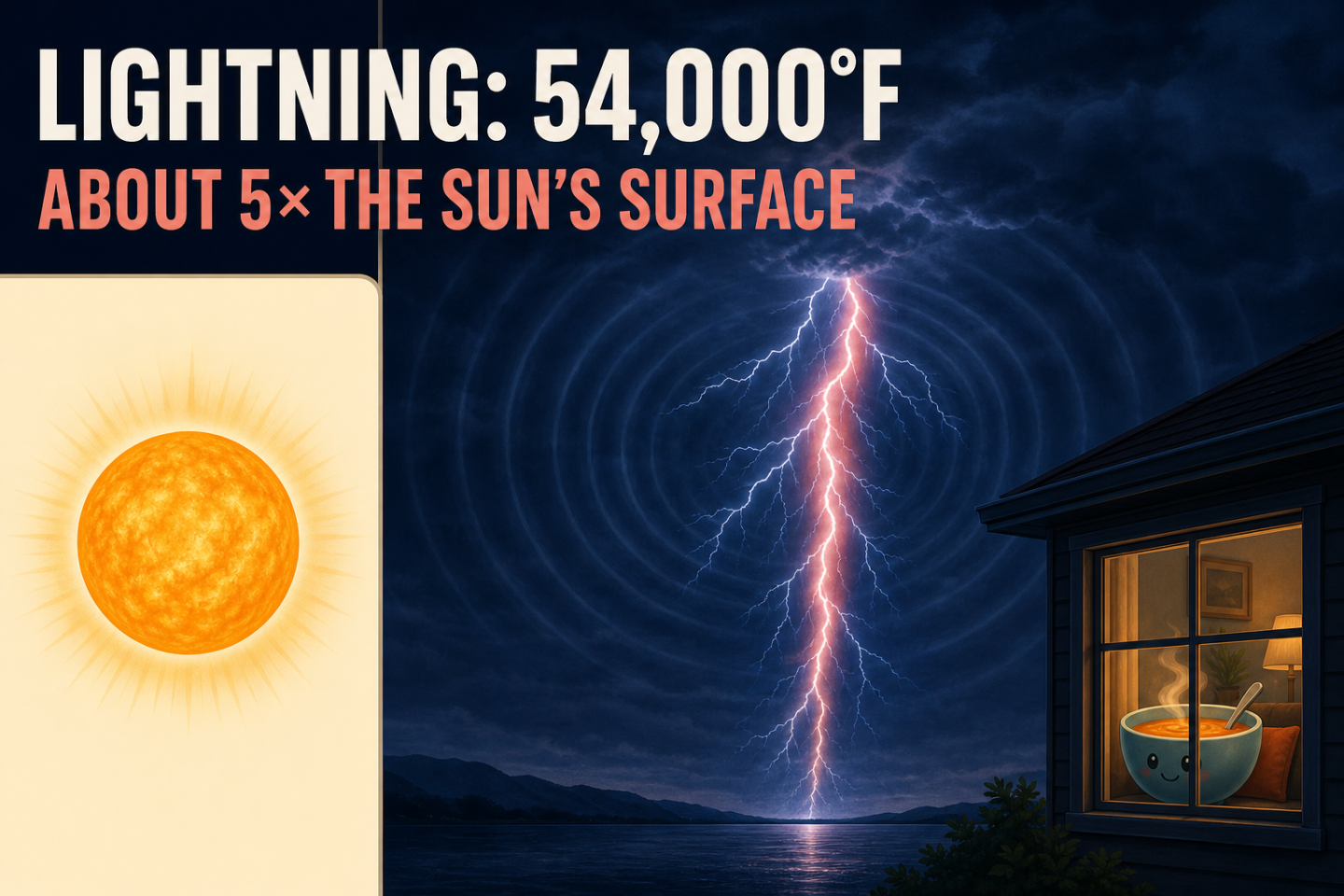
A flash of lightning lasts only a fraction of a second, yet the air beside its channel can reach about 54,000°F, or 30,000°C. That is roughly five times the temperature of the Sun’s visible surface.
The comparison sounds impossible because the Sun is vastly more powerful than any storm. The key is scale. Lightning briefly concentrates electrical energy along a narrow path through the atmosphere. It does not make an entire thunderstorm hotter than the Sun, and the lightning itself is not a solid object with one uniform temperature. The quoted temperature describes the air rapidly heated around the electrical channel.
Why air heats so dramatically
Ordinary air is a poor electrical conductor. For a lightning discharge to pass through it, a powerful electric field must break down the insulating air and create a conductive channel. Electrical current then rushes through that narrow route.
The resistance of the air converts part of the electrical energy into heat. Because the energy arrives so quickly and is confined to such a thin channel, the surrounding gas cannot expand gradually. Its temperature and pressure rise almost instantly.
This is why it is more precise to say that lightning heats the air than to say that a bolt simply “is” 54,000°F. Conditions vary along a lightning channel, and temperatures exist only briefly. NOAA uses the 54,000°F figure to explain the upper end of this rapid atmospheric heating.
From heated air to a shock wave
Gases expand when heated. Warm a pocket of air slowly and it pushes outward gently. Heat it to tens of thousands of degrees in a fraction of a second and the response is violent.
The superheated air around a lightning channel expands faster than the surrounding air can move out of the way. It compresses the air ahead of it, creating a high-pressure disturbance. Close to the channel, that disturbance is a shock wave, similar in principle to the pressure wave associated with a sonic boom.
As the wave travels outward, its sharp boundary weakens and becomes the sound wave we call thunder. A nearby discharge can produce a sudden crack or snap because high-frequency components reach the listener strongly. More distant thunder often sounds like a low, extended rumble.
Why thunder keeps rumbling
A lightning channel is not a single point. It can twist and branch across a long path through a cloud and toward the ground. Every section of that path heats nearby air and launches pressure waves.
Sound from the closest section reaches an observer first. Sound from more distant sections arrives later. Terrain, clouds, temperature layers, and the changing shape of the channel further stretch and distort the waves. The mixture of many arrival times turns one rapid electrical event into a rolling sound that may last several seconds.
Air temperature also influences how thunder travels. Sound moves faster through warmer air than cooler air. Layers with different temperatures can bend sound waves, sometimes making thunder carry farther or seem unusually loud.
Why we see lightning before hearing thunder
Light travels so much faster than sound that a lightning flash reaches our eyes almost immediately at ordinary storm distances. Thunder must move through air at the speed of sound, so it arrives later.
NOAA gives a useful estimate: count the seconds between the flash and the thunder, then divide by five to approximate the distance in miles. A fifteen-second delay suggests roughly three miles. The estimate is not a safety boundary, however. If thunder is audible at all, the storm is close enough to pose a lightning risk.
A temperature comparison with limits
The Sun’s visible surface is about 10,000°F, so lightning-heated air can briefly be several times hotter. But temperature alone does not measure total energy or danger at every distance. The Sun maintains enormous temperatures across a sphere more than a million kilometers wide. A lightning channel heats a tiny volume for a tiny interval.
A spark from a fire can also be hotter than a much larger warm object while containing far less total energy. In the same way, lightning’s remarkable temperature describes an intense local event, not a rival to the Sun’s overall power.
Thunder is a safety signal
The science behind thunder also explains why the sound should never be ignored. Thunder cannot exist without lightning. If you hear it, a discharge occurred close enough for its sound to reach you, and another strike may occur nearby. NOAA recommends moving into a substantial building or a hard-topped vehicle rather than remaining outdoors.
The boom in the sky is therefore both physics and warning: electrical energy heated a narrow air channel, the air exploded outward, and the resulting pressure wave reached your ears.