
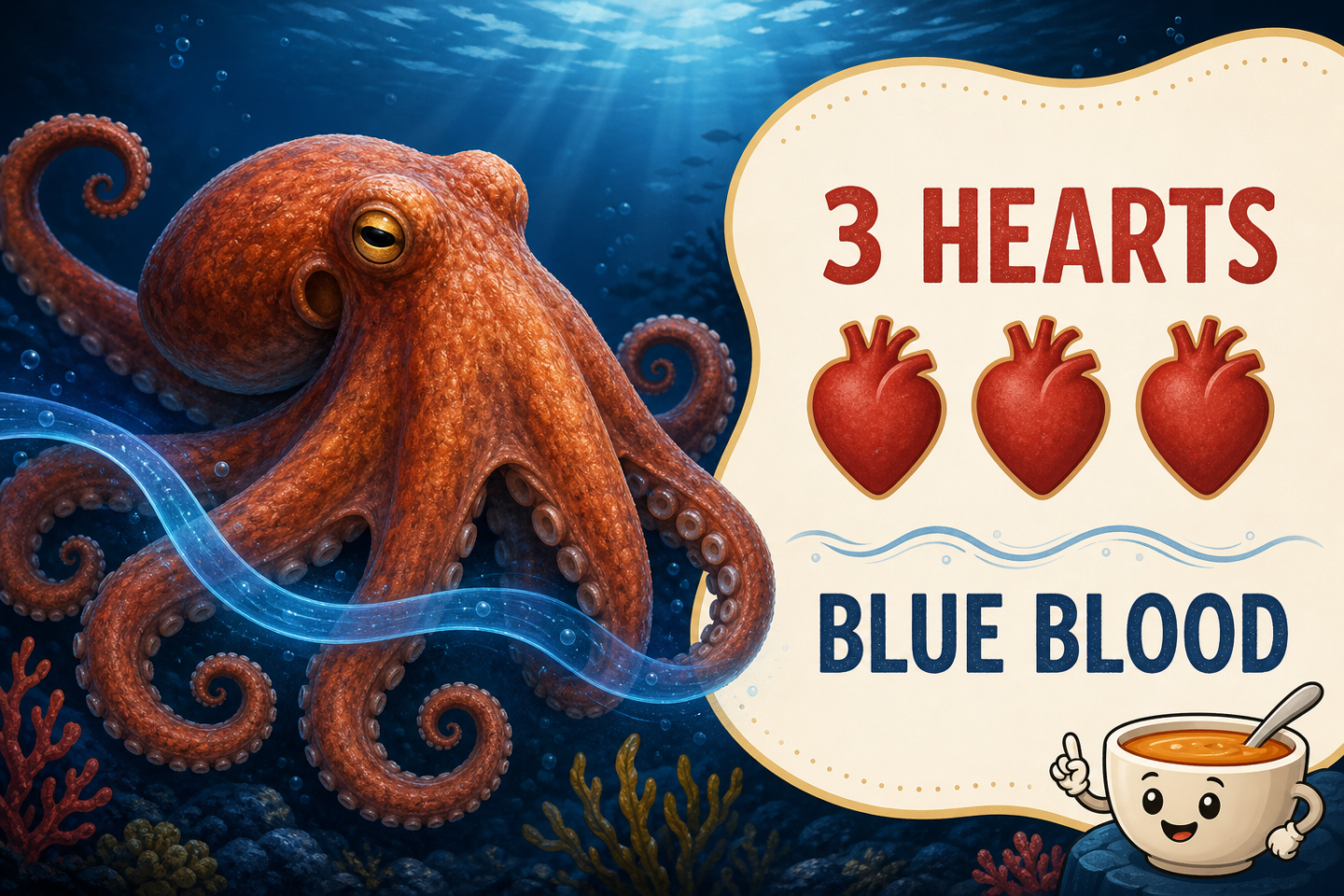
An octopus has three hearts and genuinely blue blood. Those details sound like fantasy, but both are practical parts of the cephalopod circulatory system. The three hearts divide the work of moving blood through the gills and around the body, while a copper-containing molecule called hemocyanin carries oxygen.
The result is a circulation system built differently from ours. Humans rely on one four-chambered heart and iron-based hemoglobin. An octopus uses three separate pumps and a copper-based oxygen carrier. Understanding that contrast reveals how evolution can solve the same basic problem—delivering oxygen to living tissues—in more than one way.
Three hearts with two different jobs
The hearts do not all perform identical work. Two are called branchial hearts. Each sits in the circulation serving a gill and pushes oxygen-poor blood through that gill. There, the blood can take up oxygen from the surrounding water.
After the blood has passed through the gills, the systemic heart takes over. It pumps the oxygen-rich blood through the rest of the animal. In simple terms, two pumps serve the breathing surfaces and one serves the body. The familiar statement that an octopus has three hearts is therefore more than an unusual number: it describes a division of labor.
This arrangement belongs to the broader cephalopod design. Octopuses are cephalopods, along with squid, cuttlefish and nautiluses. The Smithsonian Ocean account describes cephalopods as having two branchial hearts and one systemic heart, with the same basic circulation plan supporting their active bodies.
Why the blood looks blue
Blood color depends on the molecule used to transport oxygen. Human blood uses hemoglobin, whose iron-containing structure produces the familiar red appearance. Cephalopods use hemocyanin instead. Hemocyanin contains copper, and when it carries oxygen it gives the blood a blue color.
The phrase “blue blood” is literal here. It does not mean that octopus blood merely looks bluish through skin or under water. The oxygen-carrying chemistry itself is different. Hemocyanin binds oxygen and transports it to tissues, performing the same essential function that hemoglobin performs in vertebrates through a different molecular system.
A system suited to life in the ocean
Oxygen must move from water across the gills and then reach muscles, nerves and other tissues. That is demanding work for an active marine animal. The branchial hearts help drive blood through the gills, while the systemic heart maintains circulation through the body.
Smithsonian Ocean notes that hemocyanin works especially efficiently in cold water. Its performance can vary with environmental conditions, including temperature and acidity. That sensitivity helps explain why the molecule is not simply a blue version of hemoglobin. It has its own chemical strengths and limitations.
The circulatory system also fits into a body plan unlike that of most familiar animals. An octopus has eight flexible arms, a mantle, a funnel used in jet propulsion and, in many species, no rigid internal shell. It can move by crawling across the seafloor or by forcefully expelling water through its funnel. Supplying that muscular body with oxygen requires continuous circulation, even though the plumbing looks very different from ours.
What the heart icons do not show
Simple illustrations often place three heart symbols beside an octopus. That is a useful count, but it should not be mistaken for an anatomical map. The hearts are specialized organs connected to the gills and body circulation, not three interchangeable symbols arranged in a neat row. A symbolic comparison communicates the surprising number without pretending to show exact internal positions.
The same caution applies to the color blue. Octopus blood is blue because of hemocyanin, but that does not mean the whole animal contains bright glowing blue streams. Educational art often exaggerates color so the idea is visible. The biological fact is about the oxygen-carrying molecule, not a luminous effect.
One problem, a very different solution
Every active animal must move oxygen to its cells. Octopuses demonstrate how dramatically the machinery can differ. Their three-heart system separates gill circulation from body circulation, and their copper-based hemocyanin makes the blood blue rather than red.
That combination is memorable because it feels alien, yet it is also a clear example of ordinary evolutionary problem-solving. The task is familiar: collect oxygen and deliver it. The solution—two gill hearts, one body heart and blue blood—is unmistakably cephalopod.