
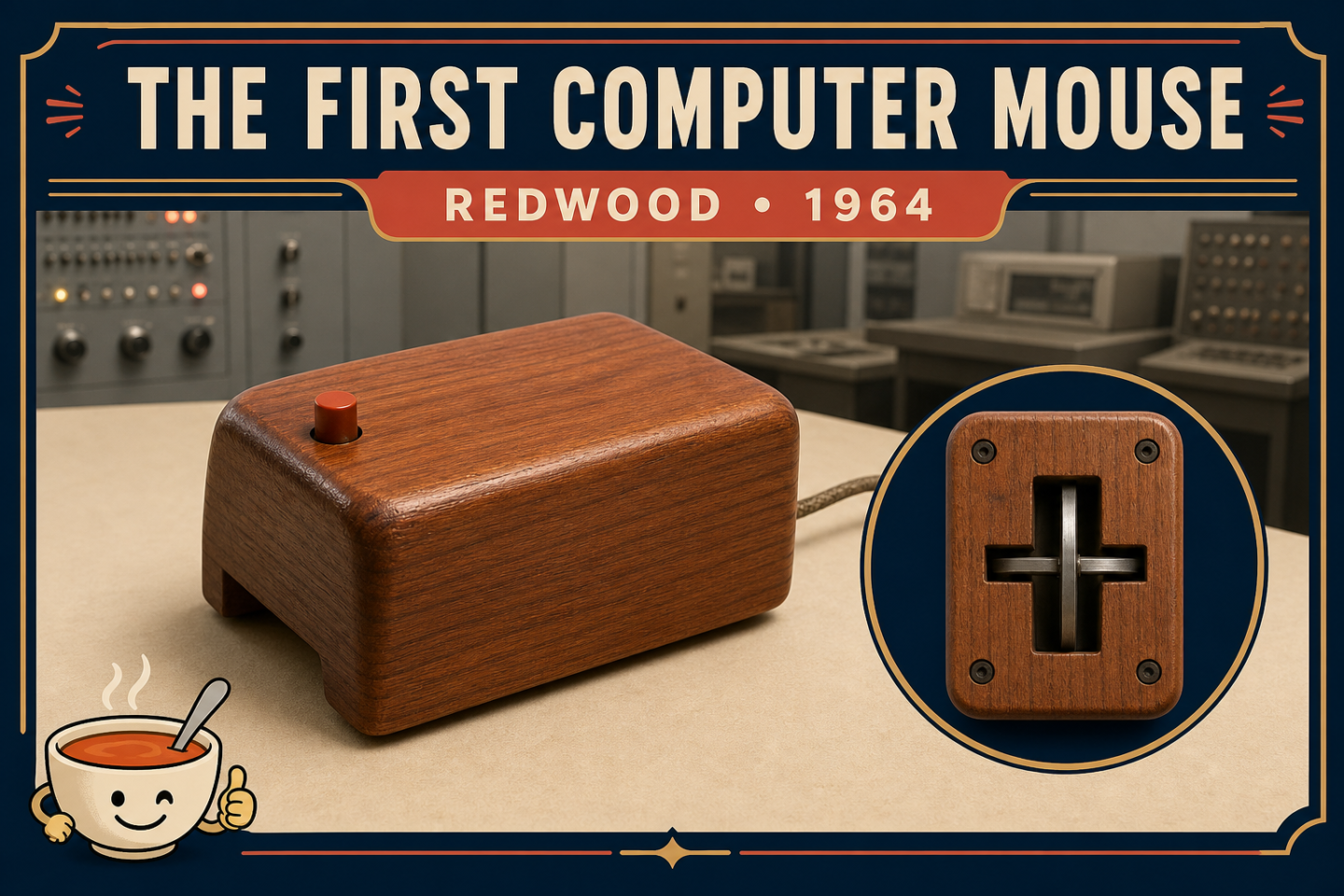
The first computer mouse looked less like a modern accessory and more like a small wooden block. Computer engineer Bill English designed the device in 1964 at Stanford Research Institute, now SRI International. The institute’s machine shop crafted its rectangular body from redwood.
Inside, two knife-edge wheels sat perpendicular to one another. One tracked motion along one axis and the other tracked motion along the second. A single button sat on top. That simple combination gave a computer a new kind of input: the movement of a hand across a desk could move a cursor across a screen.
A pointing problem
In the early 1960s, Douglas Engelbart established a research laboratory at Stanford Research Institute. His goal was not simply to make computers calculate faster. The group explored ways technology could help people organize information, collaborate and work with ideas.
A partly graphical interface created a practical problem: users needed a convenient way to point at things on a display. Light pens existed, but they were costly and required the user to reach toward the screen. Engelbart’s group tested alternatives, and the device that became the mouse offered a compact way to control a cursor from the desk.
Why two wheels mattered
The original design did not contain a rolling ball, an optical sensor or a laser. It used two sets of knife-edge wheels arranged at right angles. Moving the wooden box made the wheels turn. Because each wheel responded to motion on a different axis, the system could translate movement across a flat surface into two-dimensional cursor movement.
The geometry was straightforward but powerful. Horizontal and vertical motion could be measured independently and combined on the screen. SRI’s history of the invention notes that the early mouse used these perpendicular wheels and a single press button. Designs with more buttons followed later.
Why was it made from redwood?
The wooden case reflects its status as a research prototype. This was not a mass-produced consumer product designed for retail shelves. The SRI machine shop could shape a durable enclosure quickly, allowing the team to test the interaction rather than create polished packaging.
The Computer History Museum identifies the material specifically as redwood. Its surviving original is an important object because the familiar mouse form changed greatly as the idea moved from laboratory experiments to commercial computers. The first version was boxy and handmade, yet its basic purpose is immediately recognizable.
From research object to public demonstration
The mouse became widely visible during Engelbart’s 1968 demonstration in San Francisco, later nicknamed the “Mother of All Demos.” The presentation also showed ideas such as windows, document sharing, word processing and live video communication. The mouse was part of a broader system for interactive computing rather than an isolated gadget.
That context matters. The invention’s importance was not the wood itself, nor simply the novelty of moving a cursor. It made a graphical workspace easier to navigate. Pointing, selecting and manipulating items on a screen could become direct physical actions.
The design kept evolving
After leaving SRI for Xerox PARC, Bill English developed a ball mouse for the Alto computer. The ball replaced the original wheel arrangement and allowed motion to be captured more flexibly. Later consumer mice gained additional buttons, scroll wheels and optical sensors, while laptops and touchscreens introduced other pointing methods.
Even with those changes, the original interaction remains familiar. A device moves across a surface, a pointer responds on a screen and a button confirms a choice. The 1964 redwood prototype established that relationship in a form that people still use every day.
A wooden beginning for modern computing
The first mouse is a reminder that transformative technologies do not always begin as sleek products. Sometimes they begin as practical workshop objects built to test a better way of doing something. A redwood box, two perpendicular wheels and one button were enough to demonstrate a new connection between hand and screen.
Modern mice may use light instead of wheels and plastic instead of wood, but the central idea survives: move here, point there. That simple gesture helped make interactive computing feel natural.