
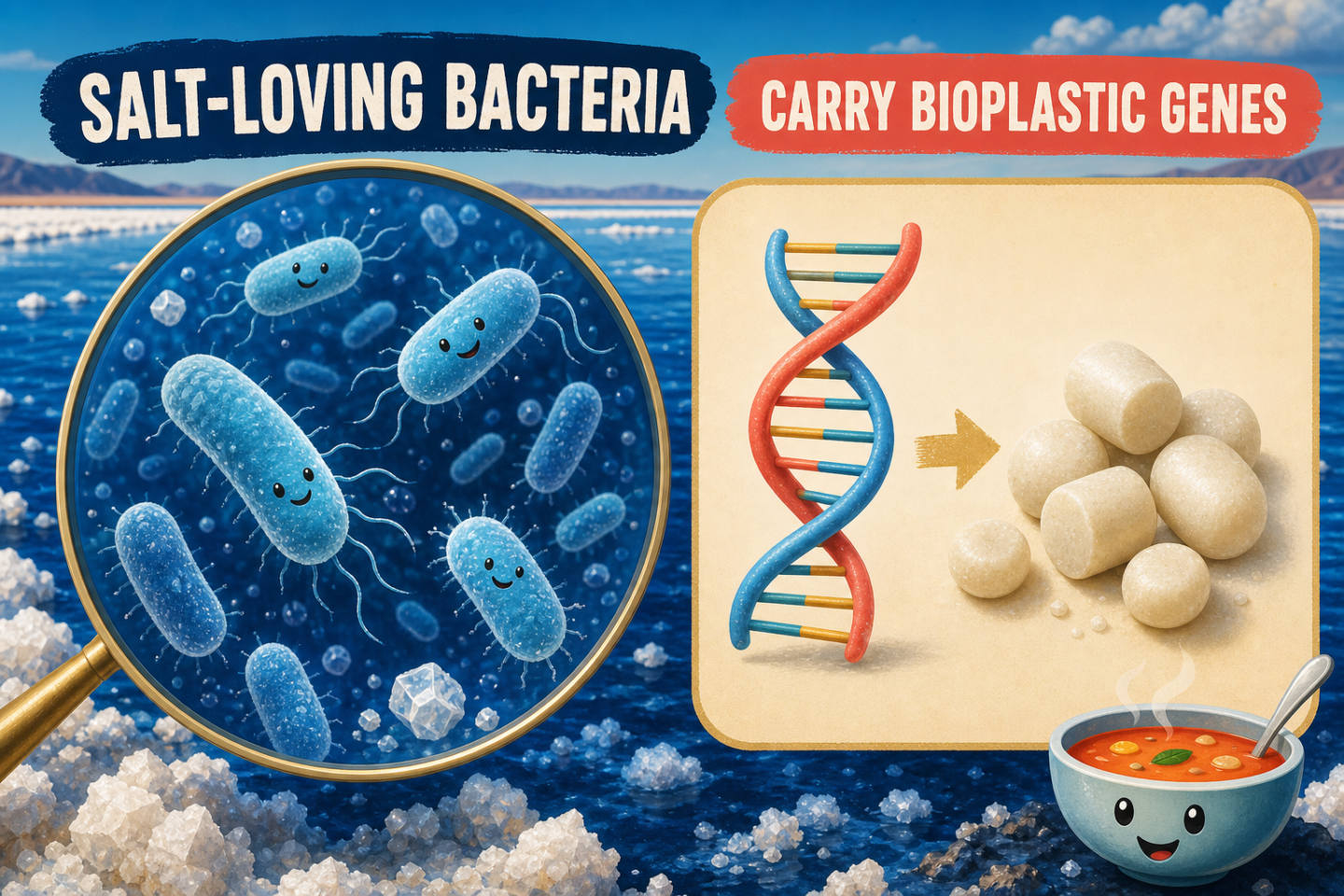
Salinivibrio bioplastic research begins with bacteria that thrive where many organisms struggle: salty environments. Members of this genus are halophiles, meaning they are adapted to high salinity. Their genomes also carry a complete toolkit for producing polyhydroxyalkanoates, or PHAs—a family of biopolymers that can be used as bioplastics.
A comparative genomic analysis examined 46 high-quality Salinivibrio genomes. Every one contained a complete core PHA biosynthesis operon, and the genes showed strong conservation. That pattern supports the idea that PHA production is a maintained biological capability across the genus rather than an isolated feature of a single strain.
What is PHA?
PHA is not one single material. The term describes a family of polyesters that microorganisms can make and store. These polymers have attracted interest because different PHAs can offer useful material properties while being bio-based and biodegradable under suitable conditions.
Microbial production works differently from making conventional petroleum-based plastics. A microorganism uses cellular chemistry to assemble the polymer from available carbon. Researchers can then investigate how much polymer a strain produces, what feedstocks it can use, what type of PHA it makes and how the material can be recovered.
The existence of a biosynthesis pathway is therefore the starting point. It tells us that an organism has the biological instructions needed to build the polymer. It does not tell us, by itself, whether the organism will produce a commercially useful amount.
The genetic toolkit inside Salinivibrio
The core operon reported across the Salinivibrio genomes contains the genes phaB, phaA, phaP and phaC. Together, these genes form a coordinated toolkit associated with PHA biosynthesis and storage. Finding the complete set in every genome analyzed matters more than finding one isolated gene.
The analysis also found high sequence conservation under strong purifying selection. In plain language, the genes have remained relatively stable as the bacteria evolved. Harmful changes appear to have been removed over time, which is consistent with the pathway serving a useful function.
Salinivibrio also has a dynamic accessory genome, meaning different strains can gain or lose many genes. The continued conservation of the PHA pathway stands out against that background. It suggests that the capacity is not merely genomic clutter.
Why salt-loving bacteria are interesting
Halophiles are specialists. Their cellular systems operate in environments with salt concentrations that would stress many other microbes. That makes them scientifically useful for understanding how life adapts to chemical extremes and potentially useful as hosts for biotechnology.
Salt tolerance alone does not guarantee a better bioplastic process. Any practical system must be evaluated for growth, productivity, feedstock use, polymer quality, recovery costs and reliability. Still, a salt-adapted organism with a conserved PHA pathway offers a clear platform for testing those questions.
Genes are evidence, not a factory
Genome results are sometimes described too quickly as proof that an organism can solve an industrial problem. The more accurate interpretation is narrower: Salinivibrio has the conserved genetic machinery associated with PHA biosynthesis, and that machinery supports further laboratory and engineering work.
The same analysis identified several putative PHA depolymerases—enzymes that may help break PHA down—but these candidates remain unconfirmed. Their sequences contain expected catalytic residues, yet biochemical experiments are still needed to establish what the enzymes actually do.
This distinction is important. A genome is a set of instructions, not a performance report. Researchers must still measure whether the instructions are active, how they respond to conditions and whether the resulting process can be controlled.
From microbial genes to useful materials
Developing a PHA bioplastic system involves several linked steps. A suitable strain must grow on an affordable input, channel enough carbon into polymer, tolerate the production conditions and generate a material with useful properties. The polymer then has to be separated and processed without erasing its environmental advantages.
Salinivibrio does not skip those challenges. What it offers is a well-supported biological foundation: salt tolerance plus a conserved PHA biosynthesis toolkit. That combination makes the genus a promising subject for experiments on microbial biopolymer production.
A small organism with a material blueprint
The surprising part is not that bacteria can interact with plastic. It is that some bacteria naturally carry instructions for building polymer inside their cells. In Salinivibrio, those instructions appear across a broad genomic sample and remain strongly conserved.
That does not mean salt-lake microbes are ready to replace a plastics factory. It means biology already contains a blueprint worth understanding. Turning that blueprint into a useful material is the next, much harder layer of the problem.