
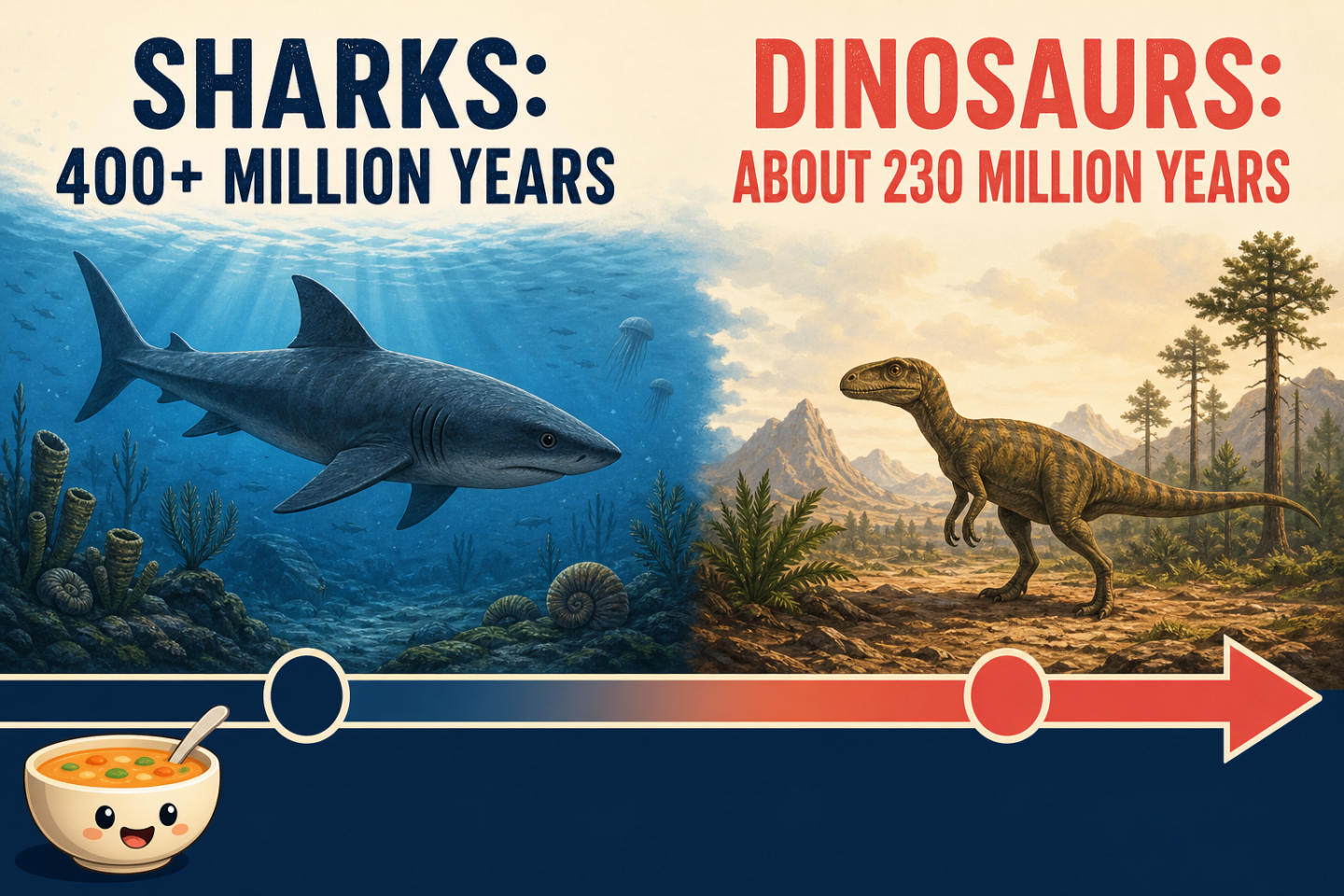
Sharks were already swimming through ancient waters long before the first dinosaurs walked on land. The earliest sharks evolved more than 400 million years ago, while the U.S. National Park Service places the earliest true dinosaur fossils at roughly 235 million years ago. That gives sharks a head start of well over 150 million years.
This comparison does not mean modern shark species have remained unchanged since that distant past. Sharks have evolved, diversified and disappeared in many forms. The remarkable fact is that the broader shark lineage reaches back to a world far older than the age of dinosaurs.
How much older are sharks than dinosaurs?
The Smithsonian Ocean Portal describes the first sharks as having evolved more than 400 million years ago. By comparison, the National Park Service says dinosaurs existed from approximately 235 million years ago until 66 million years ago, excluding the birds that survive as living dinosaurs.
Using those rounded dates, sharks preceded the earliest known true dinosaurs by about 165 million years. That span is longer than the entire period during which non-bird dinosaurs existed. It is an enormous interval, even by the standards of deep time.
What counts as an early shark?
The oldest shark evidence is incomplete. Smithsonian Ocean notes that confirmed shark scales from Siberia date to about 420 million years ago, during the Silurian Period. Some of the oldest shark teeth date to around 400 million years ago in the Devonian Period.
These remains do not give scientists a complete portrait of the animals. A scale or tooth can establish that a shark relative existed, but it cannot reveal every feature of the body. The earliest forms may have looked quite different from familiar sharks alive today. By roughly 370 million years ago, however, the fossil record includes ancient sharks that were recognizably related to the group we know.
Why are complete shark fossils rare?
Dinosaurs had bony skeletons that could sometimes survive burial and fossilization. Sharks belong to a group of fishes whose skeletons are built mainly from cartilage. Cartilage is lighter and more flexible than bone, but it usually breaks down before it can fossilize.
Teeth are the major exception. Sharks continually replace teeth throughout their lives, and those hard, mineralized structures preserve much more readily. Fossilized scales, called denticles, also provide important evidence. Vertebrae and impressions of soft tissue are found more rarely.
That uneven record is why shark paleontology often resembles detective work. Researchers compare the shapes and structures of teeth, scales and occasional body remains to reconstruct relationships among animals separated by hundreds of millions of years.
Sharks survived a changing planet
The shark lineage passed through repeated environmental upheavals and mass extinctions. Smithsonian Ocean explains that ancient shark groups suffered losses during these crises, while surviving branches continued to evolve and diversify.
The Permian-Triassic extinction around 251 million years ago was especially severe. Many shark species disappeared, but the lineage persisted. Sharks later shared Mesozoic seas with large marine reptiles while dinosaurs dominated many land environments. The extinction event 66 million years ago eliminated non-bird dinosaurs, yet many shark, ray and skate families survived.
Ancient does not mean unchanged
Calling sharks ancient can create the wrong impression that living sharks are frozen relics. Modern species are the results of continuing evolution. Great whites, hammerheads, whale sharks and tiny lanternsharks occupy very different ecological roles and do not simply reproduce a 400-million-year-old body plan.
Even groups with deep fossil histories have changed over time. The shark family tree includes many extinct experiments in body shape, feeding and habitat. Some ancient forms would look unfamiliar beside a modern reef shark.
A longer story than the dinosaurs
Dinosaurs remain the most famous inhabitants of the prehistoric world, but they entered a planet where the shark lineage was already extraordinarily old. Before forests looked modern, before flowering plants existed and long before familiar land animals appeared, shark relatives were moving through ancient waters.
Their history is not a single unbroken design. It is a record of adaptation across changing oceans, continents and extinction events. The fact that sharks still live in every major ocean makes that deep history visible in the present.