
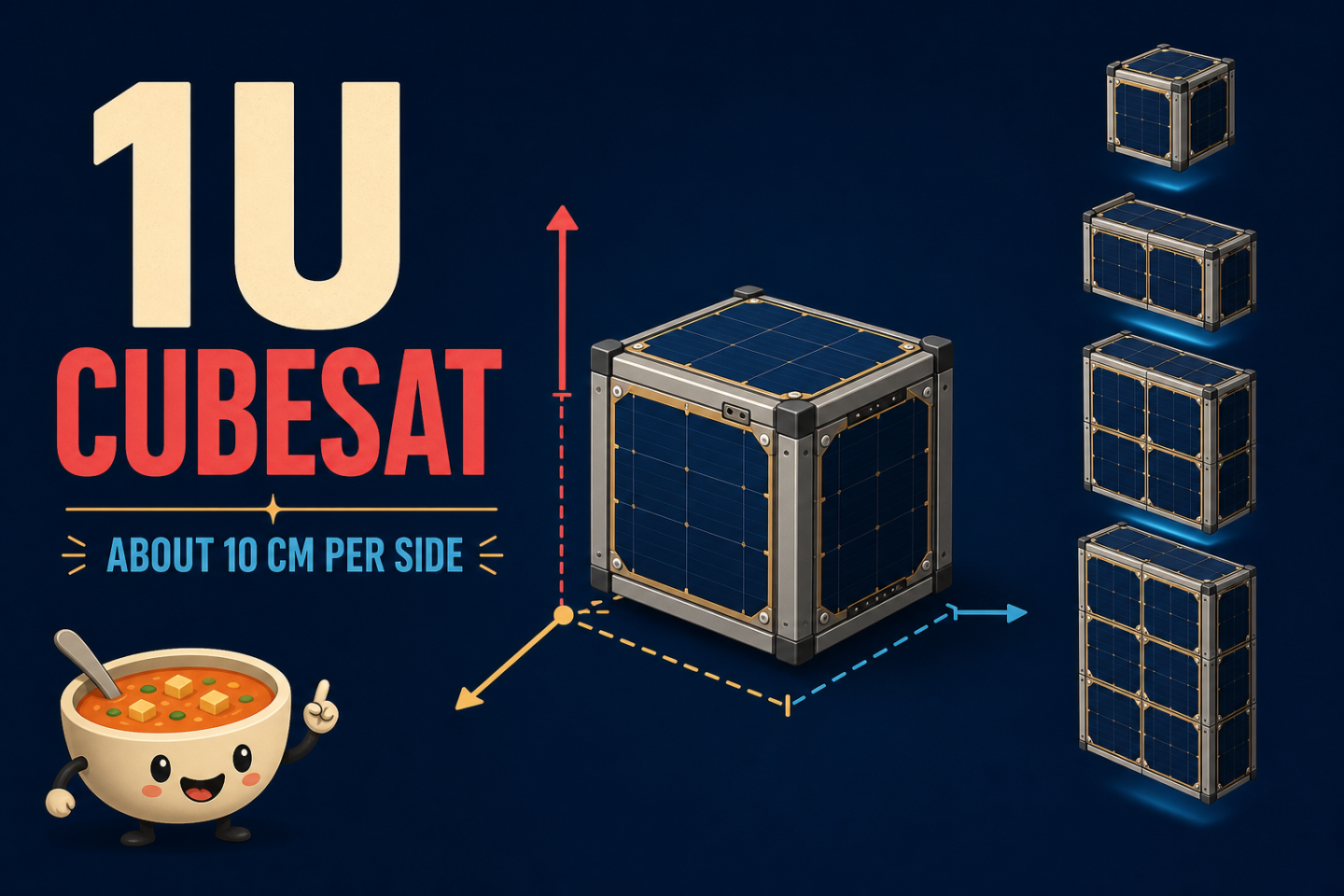
A satellite does not have to be the size of a bus. A standard 1U CubeSat occupies a volume of about 10 by 10 by 10 centimeters—roughly a cube that could sit in two hands. NASA says a unit typically weighs less than 2 kilograms.
The name describes a standardized form rather than one specific spacecraft. CubeSats can carry computers, radios, sensors, cameras and other equipment, but their bodies are assembled around familiar modular dimensions. Larger versions combine multiple units, written as 2U, 3U, 6U, 12U and beyond.
What does 1U mean?
The letter U stands for unit. It is the basic building block of the CubeSat form factor. NASA’s CubeSat Launch Initiative describes 1U as a cube-shaped volume measuring about 10 centimeters on each side.
Real spacecraft need rails, structural clearances and interfaces, so detailed engineering specifications can vary slightly from the simple rounded dimensions used in public explanations. The important idea is the modular standard: teams design their spacecraft to fit a known envelope rather than inventing every external dimension from scratch.
How do larger CubeSats work?
Engineers can join several units to create more room. A 2U CubeSat resembles two units placed end to end. A 3U design uses three, while 6U and 12U spacecraft arrange larger blocks of the same modular idea.
More volume can support larger solar panels, batteries, antennas, propulsion systems or scientific instruments. It also increases design complexity. Engineers must still manage mass, power, heat and communication while protecting the spacecraft from vibration during launch and radiation in orbit.
Why standardize a satellite?
Standardization helps connect spacecraft design with launch hardware. CubeSats are often placed inside protective containers called deployers. The deployer holds the small spacecraft during launch and releases it after the rocket or carrier spacecraft reaches the intended location.
When a CubeSat fits an established form factor, launch providers can work with familiar mechanical interfaces. Component makers can also offer parts designed for common unit sizes. NASA notes that this approach provides a lower-cost path for scientific investigations and technology demonstrations.
Lower cost does not mean a CubeSat is simple. A working satellite must survive launch, produce or store power, communicate with Earth, control its temperature and operate reliably in space. Packing those functions into a small volume is a demanding engineering exercise.
Where did the CubeSat idea come from?
NASA explains that the CubeSat form factor was developed in 1999 through work at California Polytechnic State University and Stanford University. The original goal was to provide an accessible platform for education and space exploration.
The standard allowed students and university teams to gain hands-on experience with real flight hardware. CubeSats later expanded well beyond classrooms. Government agencies, universities and companies now use them for science, technology testing and mission concepts involving groups of spacecraft.
What can a tiny satellite do?
CubeSats have carried cameras, atmospheric sensors, radiation detectors and experimental communication equipment. Some demonstrate components before they are used on larger missions. Others gather focused scientific measurements or operate as part of a coordinated group.
The size sets hard limits. A small body offers less area for solar power and antennas, less room for shielding and fewer options for thermal control. Engineers respond with miniaturized electronics, efficient software and carefully chosen mission goals.
That tradeoff is central to CubeSat design. A small spacecraft may not replace a large observatory, but it can test a focused idea, collect complementary data or make a mission possible within a tighter budget and schedule.
A small box with a large influence
The CubeSat standard changed how many teams approach space hardware. Instead of beginning with an unlimited shape, designers can start with a known unit and ask what useful mission can fit inside it.
A 10-centimeter cube sounds modest, yet it represents a complete spacecraft framework. Combine several units, add carefully selected systems and that small modular box can become a laboratory orbiting Earth—or a technology demonstrator traveling far beyond it.