
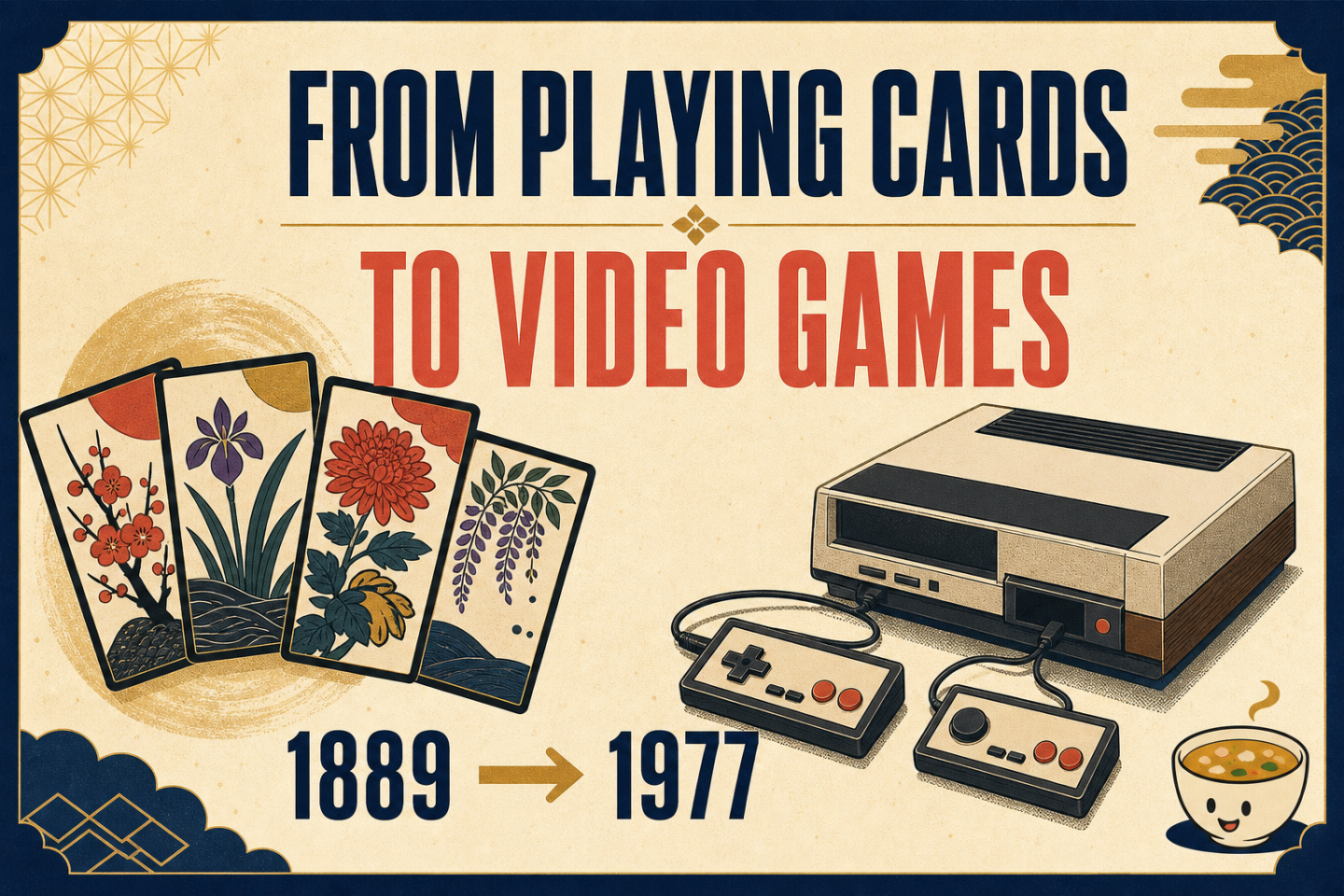
Nintendo is now closely associated with electronic games, but its official timeline begins in a very different medium. In 1889, Fusajiro Yamauchi began manufacturing and selling Japanese playing cards called hanafuda in Shimogyo-ku, Kyoto. Nintendo would not launch its first home video game machines until 1977. Those two milestones are 88 years apart.
That long interval makes Nintendo a useful example of how a company’s identity can endure even when its products and technology change dramatically. The move from physical cards to electronic play was not one sudden leap. Nintendo’s own company history records a sequence of changes in products, organization, and technology along the way.
A company history that starts with cards
The official Nintendo Company History states that Fusajiro Yamauchi began manufacturing and selling hanafuda in Kyoto in 1889. Hanafuda are Japanese playing cards, so the company’s earliest recorded business was already connected to play, but not to screens, software, or electronics.
The timeline shows that playing cards remained important for decades. Nintendo began manufacturing and selling Western playing cards in 1902. In 1951, the company adopted the name Nintendo Playing Card Co., Ltd. Two years later, it became the first company in Japan to succeed in mass-producing plastic playing cards, according to the same official history.
The name changed before the medium did
The corporate timeline also helps separate the history of the business from the history of its present-day name. In 1947, Marufuku Co., Ltd.—described by Nintendo as the previous incarnation of Nintendo Co., Ltd.—was established in Kyoto. The company became Nintendo Playing Card Co., Ltd. in 1951 and adopted its current name, Nintendo Co., Ltd., in 1963.
That 1963 name change came 14 years before the first home video game machines listed in Nintendo’s history. In other words, the modern company name predates its home video game business. The sequence is a reminder that a familiar brand name does not necessarily begin with the product category most people now associate with it.
Entertainment experiments came before home consoles
Nintendo’s transition toward electronic games had intermediate steps. Its official history says the company developed the Laser Clay Shooting System for leisure facilities in 1973. Then, in 1977, it launched TV Game 15 and TV Game 6, which Nintendo identifies as its first home video game machines.
The dates matter because they show that the shift was gradual. Nintendo’s timeline moves from cards to other forms of entertainment and then to home electronic games. In 1978, the company developed and began selling arcade video game machines. In 1980, it developed and began selling Game & Watch, a handheld electronic game line, and established a wholly owned subsidiary in the United States.
Home video games became a more visible part of the timeline in 1983, when Nintendo launched the Family Computer System, known as the Nintendo Entertainment System outside Japan. That milestone arrived six years after TV Game 15 and TV Game 6, not at the beginning of the company’s home gaming history.
What the 88-year gap really shows
It is tempting to summarize the story as a simple jump from cards to consoles, but the official dates describe a longer process. Playing cards were not a brief prelude: they formed a business that lasted across generations, new card formats, manufacturing changes, and multiple corporate names. Electronic entertainment appeared much later.
The continuity lies less in a specific technology than in the broader activity of play. Cards and video games use very different materials and systems, yet both create rules, choices, competition, and shared experiences. That connection is an interpretation of the timeline rather than a claim that Nintendo followed a predetermined plan. Nothing in an 1889 card business made video games inevitable.
What the record does establish is striking enough on its own. Nintendo’s history began with hanafuda in 1889. Its first home video game machines arrived in 1977. The company most people recognize for digital entertainment spent the greater part of its early history making and selling forms of play that required no screen at all.