
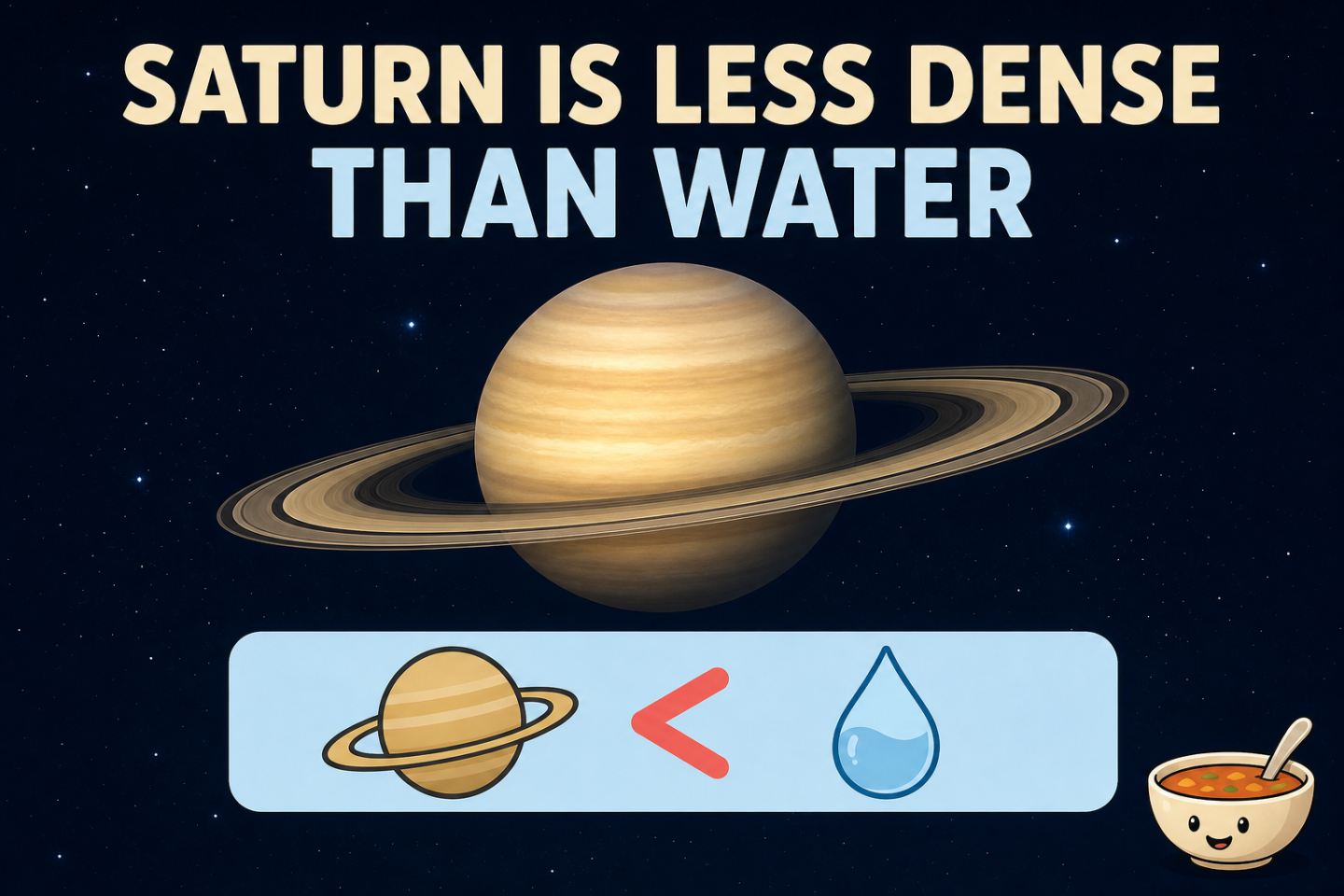
Saturn is about nine times wider than Earth, but size alone does not tell us how tightly matter is packed inside a world. According to NASA’s Saturn facts, Saturn is the only planet in our solar system whose average density is lower than that of water. That sounds almost impossible for the second-largest planet orbiting the Sun, yet it follows from Saturn’s composition and internal structure.
The comparison is often turned into a memorable picture: Saturn floating in an impossibly large container of water. That image is useful as a density analogy, but it should not be taken as a literal experiment. No ocean or container could hold a planet, and Saturn does not have a solid outer surface that could be lowered into water like a ball.
Average Density Is a Whole-Planet Measurement
Density describes how much mass is contained within a given volume. For a planet, scientists use the total mass and the volume represented by its overall size to calculate an average. That word—average—matters. Saturn is not equally dense from its cloud tops to its center.
The visible planet is wrapped in an atmosphere dominated by hydrogen and helium, two very light elements. Deeper down, increasing pressure changes the physical state of the material. NASA describes layers of liquid hydrogen and liquid metallic hydrogen surrounding a dense core that includes metals, rocky material, and other compounds. The interior is therefore far denser than the upper atmosphere, even though the average across the planet remains remarkably low.
This distinction prevents a common misunderstanding. “Less dense than water” does not mean every part of Saturn is less dense than water. It means that when the mass of the entire planet is compared with its enormous volume, the resulting average falls below the density benchmark represented by water.
Why a Giant Planet Can Have a Low Average Density
Saturn formed about 4.5 billion years ago as gravity gathered gas and dust in the young solar system. Like Jupiter, it retained huge amounts of hydrogen and helium. Those light ingredients occupy an immense volume, which helps explain why Saturn can be extraordinarily massive while still having a low average density.
Gravity compresses the material more strongly toward the center, but the planet’s broad outer regions remain dominated by comparatively light substances. Saturn’s great size is therefore not evidence that it is uniformly packed with heavy rock or metal. A world’s diameter and its density answer different questions: one describes scale, while the other describes how mass is distributed through that scale.
There Is No Solid Surface to Land On
NASA classifies Saturn as a gas giant and notes that it has no true surface. The atmosphere gradually gives way to denser gases and liquids as depth, pressure, and temperature increase. There is no clear, solid boundary comparable to the ground beneath our feet on Earth.
A spacecraft could not simply pass safely through the planet. As it descended, the rising pressure and temperature would eventually crush, melt, and vaporize it. This makes the water comparison even more clearly symbolic: Saturn is not a rigid object with a waterproof exterior. It is a layered planetary system whose materials change dramatically with depth.
What the Water Comparison Actually Teaches
The point of comparing Saturn with water is not to propose a cosmic flotation test. It is to make an invisible property—average density—easy to remember. The comparison overturns an intuitive assumption that larger objects must always be denser than smaller ones.
It also shows why planetary science depends on more than pictures. Saturn’s clouds and rings are spectacular, but measurements of mass, size, composition, gravity, pressure, and temperature reveal the planet beneath the appearance. From those measurements emerges a stranger and more accurate picture: a giant world built mostly from light elements, with no true surface and a density unlike that of any other planet in our solar system.