
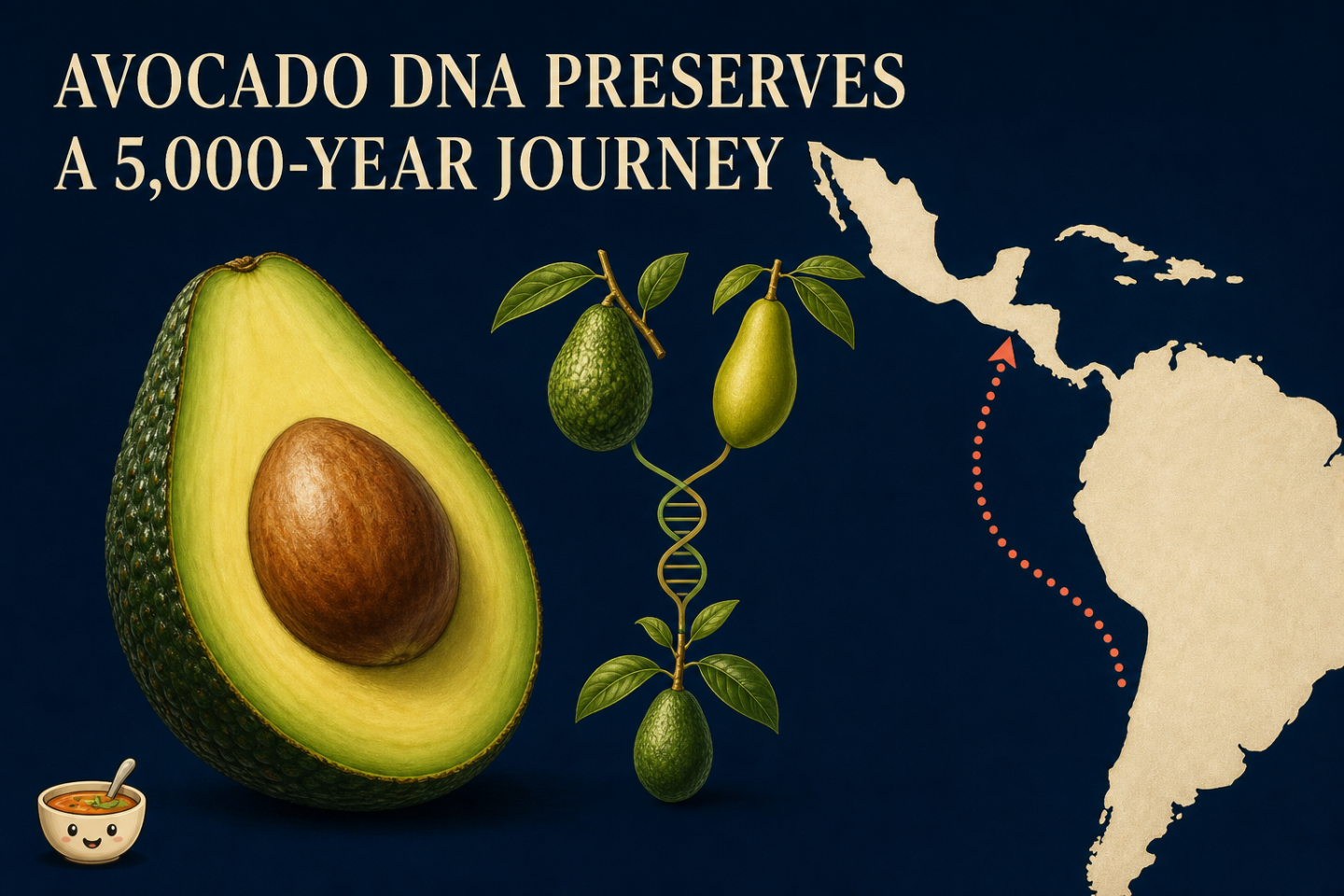
An avocado tree can preserve a kind of travel record. Not a diary written in words, but a pattern in its DNA that connects living plants across distant parts of the Americas.
Genetic evidence from traditional avocado varieties suggests that people transported avocados with South American ancestry north into the lowlands of Nicaragua about 5,000 years ago. Those plants later hybridized with local avocados, helping create a distinctive pocket of diversity in Central America. This interpretation does not trace one seed or one traveler. It reconstructs a population-level history from relationships among living avocado lineages.
A history written in avocado DNA
The peer-reviewed analysis examined DNA from 47 native avocado landraces collected in Nicaragua, Honduras, and southern Mexico. Thirty-two of the sampled landraces came from Nicaragua. Researchers compared those samples with previously published genetic information from more than 200 other avocado lineages.
The comparison revealed a geographic contrast. Samples from southern Mexico were closely related to ancestral highland populations elsewhere in Mexico and to commercial varieties. Many landraces from Nicaragua’s lowlands, however, showed genetic ties to avocado populations farther south, including populations along Colombia’s coast.
That pattern is the foundation of the 5,000-year journey. The researchers interpret it as evidence that people moved avocado seeds or plants north from South America. The ancestry later mixed with avocados already growing in the humid Central American lowlands.
What is an avocado landrace?
A landrace is a locally maintained plant population shaped through repeated cultivation in a particular place. Unlike a highly uniform commercial cultivar, a landrace may preserve substantial variation. Farmers and gardeners keep planting, selecting, sharing, or grafting trees whose fruit and growing traits suit local conditions and preferences.
That makes landraces valuable evidence for avocado history and domestication. Their DNA reflects biological inheritance, while their distribution also reflects human choices. A tree growing in one region may carry ancestry from another because people valued its fruit, transported its seed, and continued to cultivate its descendants.
The researchers paired genetic sampling with ethnobotanical information from farmers and gardeners. This combination matters because plant diversity is not shaped by genes alone. Agricultural knowledge and everyday decisions about which trees to preserve also influence what survives across generations.
Movement followed by mixing
The evidence points to hybridization rather than a simple replacement of one avocado population by another. Avocados with southern ancestry reached Central America and crossed with local varieties. Their descendants therefore carried a mixture of genetic histories.
This mixing helps explain why avocado origin is more complicated than a single birthplace followed by a one-way spread. Domestication can unfold through repeated movement, exchange, cultivation, and hybridization. Plants travel with people, then encounter related plants in a different landscape. Over many generations, the result can become a locally distinctive population.
The Nicaraguan lowland landraces are also not simply the same as the familiar commercial avocado used in much of the global food trade. They form part of a broader and less uniform reservoir of avocado diversity. Their history belongs to local cultivation as much as to the deeper ancestry that DNA can reveal.
How certain is the 5,000-year date?
DNA does not contain a label stating when a seed crossed a border. Researchers infer historical relationships by comparing genetic patterns among populations and placing those patterns beside archaeological evidence for the movement of crops. In this case, the estimated relocation around 5,000 years ago also falls near the period when other crops with South American connections appear in the Central American archaeological record.
The careful wording is therefore important: the genetic evidence suggests human transport around that time. It does not identify the exact route, the number of journeys, or the communities involved. Nor does it mean that every avocado in Nicaragua shares the same history. The conclusion describes ancestry detected in sampled lowland landraces and the most plausible explanation for its geography.
Why this journey matters
The finding turns avocado history into a story of connection. Long before standardized commercial orchards, people were moving useful plants across regions and cultivating them in new environments. The trees changed too, hybridizing with local avocados and preserving that encounter in their descendants.
Avocado DNA lets researchers recover part of that story from living plants. The result is not a tidy tale of one origin and one migration. It is a layered history in which human movement, local knowledge, plant domestication, and biological mixing all contributed to the diversity that survives in Central America.