
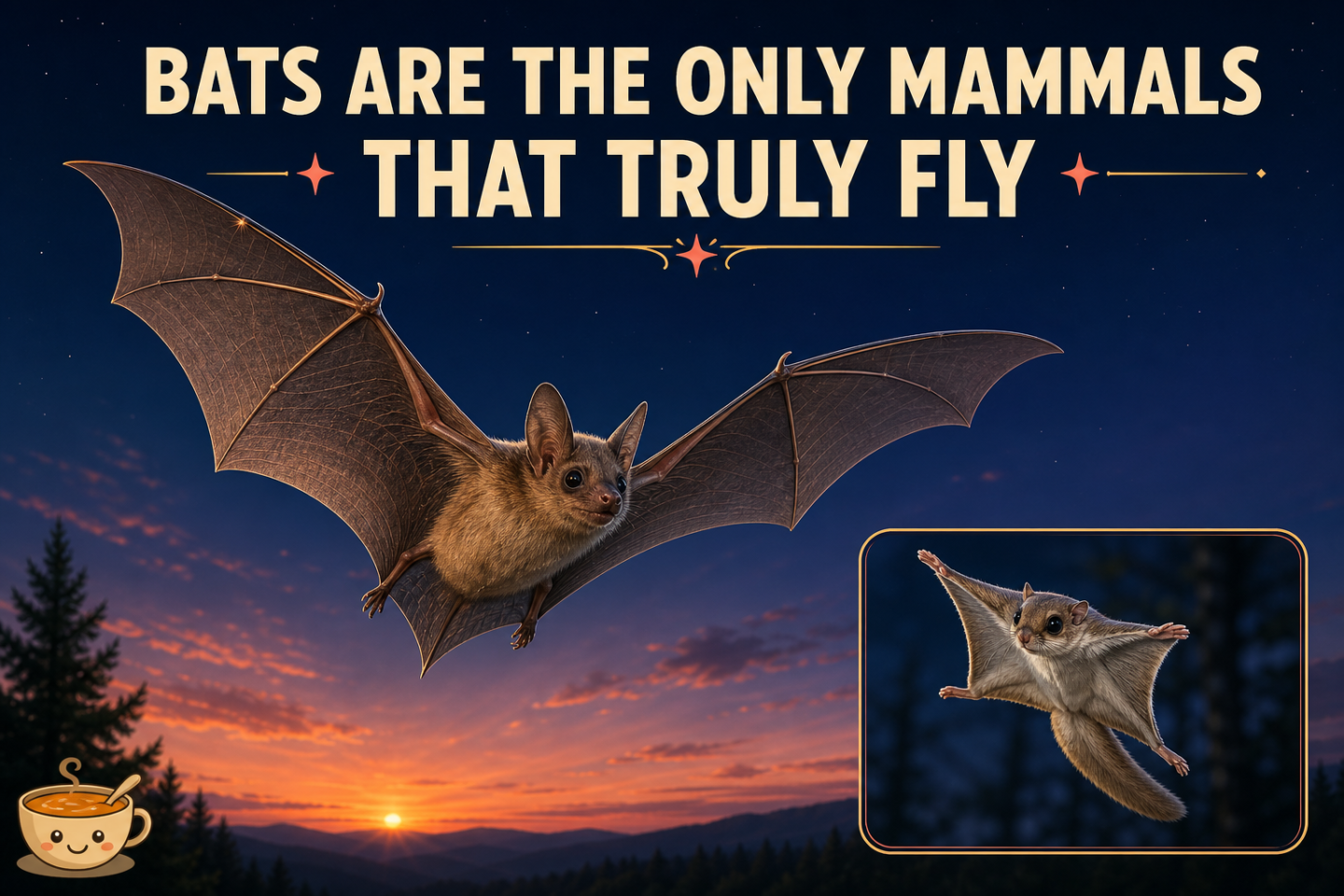
Watch a bat and a flying squirrel move through the air, and both may look like fliers. The resemblance ends at the source of the motion. A flying squirrel glides on a membrane; a bat repeatedly beats its wings.
Among living mammals, bats alone are capable of true powered flight. A flying squirrel’s membrane enables a glide; a bat actively moves its wings through repeated beats. The difference becomes much easier to understand when the wing is seen not as a loose flap attached to the body, but as a highly modified forelimb.
Airborne is not the same as powered flight
The Smithsonian Institution draws the distinction directly: so-called flying squirrels and flying lemurs glide or parachute using a furred membrane, while only bats have the structural adaptations for full powered flight.
That makes the name “flying squirrel” a little deceptive. It captures what the animal looks like while airborne, but not how it moves. In this comparison, gliding is the controlled airborne motion; powered flight is the repeated, active wingbeat that keeps a bat flying. The contrast is about mechanism, not about whether both animals can travel through the air.
A wing built around long fingers
Bats belong to the order Chiroptera, a name that means “hand-wing.” The name is unusually literal. The National Park Service describes a bat wing as resembling a modified human hand: picture the skin between the fingers made larger, thinner, and stretched.
Four finger bones are long and slender. They support, spread, and help manipulate the wing membrane, while the thumb usually remains free and bears a claw. The membrane is living tissue: Smithsonian’s account describes two thin layers of skin containing blood vessels, nerves, and tendons.
This anatomy gives the wing both structure and flexibility. The National Park Service notes that the membrane stretches between long finger bones and many movable joints, helping make bats agile fliers. Smithsonian likewise connects the arrangement of the membrane, bones, and muscles with the lightness and maneuverability needed in flight.
What “only” means here
The claim is narrowly about living mammals and powered flight. It does not deny that other mammals can move impressively through the air. Smithsonian specifically names flying squirrels and “flying” lemurs, which use membranes to glide or parachute. They solve an airborne travel problem without the powered wingbeat of bats. Keeping that boundary clear prevents a vivid nickname from becoming a biological category.
The hand explains the difference
Think of the bat wing as an articulated hand rather than a rigid paddle. That is an analogy, but it points to the literal anatomy: an arm, elongated fingers, movable joints, and a flexible membrane working together as a flight surface. A flying squirrel’s membrane supports a glide; a bat can actively beat and control its finger-supported wings.
The surprise, then, is not simply that a mammal has something wing-shaped. It is that a familiar mammalian forelimb has the structure needed to power flight. Once you notice the long fingers inside the silhouette, the bat’s unusual place among living mammals becomes visible: the “wing” is also a hand.