
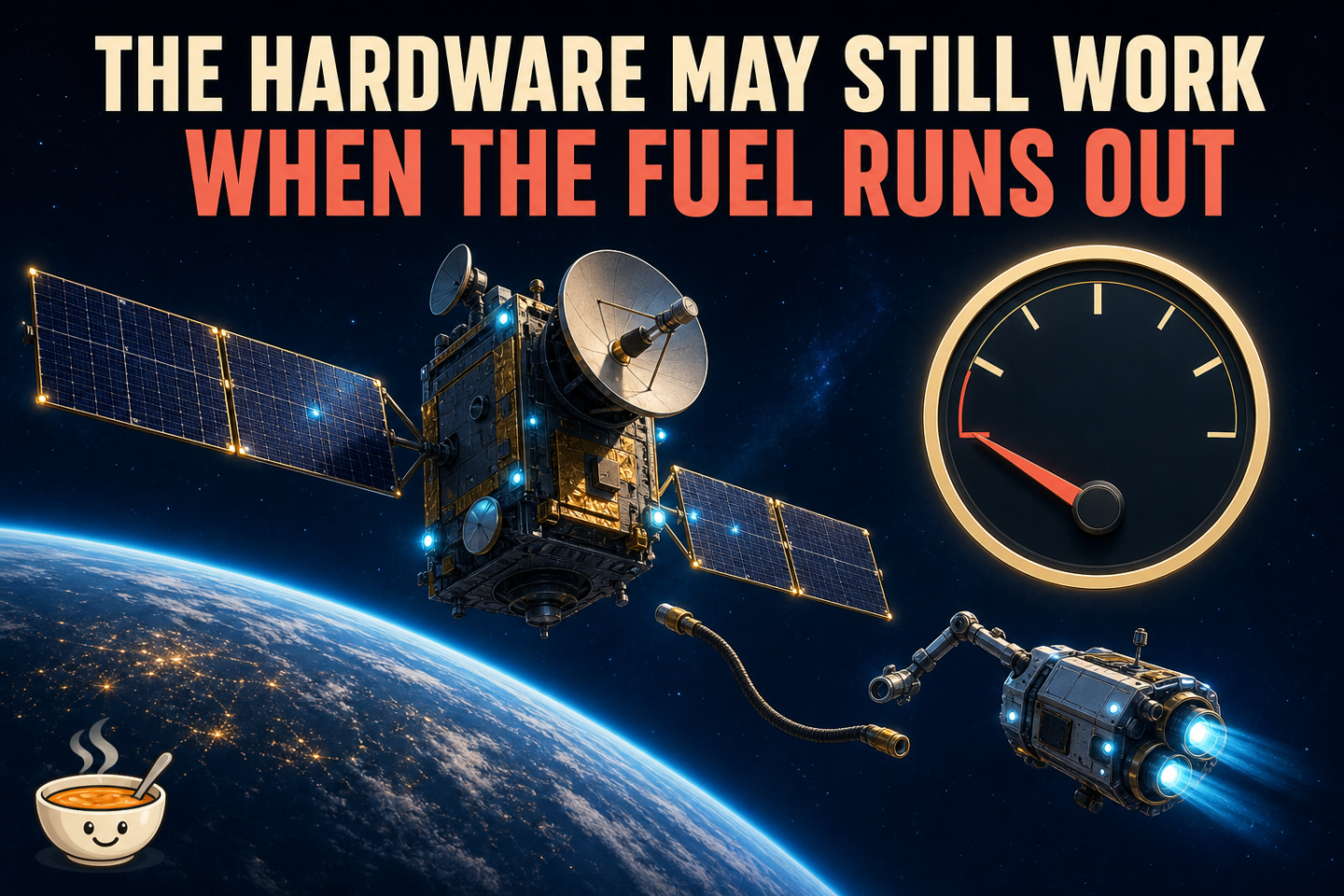
A satellite’s career does not always end with a dead computer or broken instrument. NASA’s In-Space Servicing, Assembly, and Manufacturing program says costly satellite hardware may still be operational when fuel runs out or onboard technology becomes obsolete. In other words, an otherwise functioning spacecraft can reach the end of useful service because one mission-critical resource is gone.
The fuel itself does not power every electronic component. The problem is what a satellite may no longer be able to do without propellant. NASA explains that when satellite fuel tanks are empty, the spacecraft can no longer maintain its orbit. The useful correction is simple: working hardware and a sustainable mission are not the same thing.
Why an empty tank can be mission-ending
Fuel is not only relevant during the trip to space. Once deployed, a satellite may still need propellant for the orbit maintenance on which its mission depends. If that propellant is exhausted, an instrument may remain capable of collecting data while the spacecraft can no longer support the orbit required for continued operations.
This is not a rule that every satellite retires because of fuel. Spacecraft can fail for many other reasons, and different designs face different limits. The NASA material supports a narrower point: fuel depletion can end orbit maintenance, while useful hardware may still remain aboard. That distinction is exactly why servicing is interesting.
Servicing addresses more than one kind of limit
NASA gives satellite servicing three straightforward goals: refuel, repair, or upgrade a spacecraft once it is in space. Those verbs describe different problems. Refueling addresses depleted propellant. Repairing addresses something that has stopped working. Upgrading addresses hardware or technology that has become outdated even though the spacecraft itself may remain operational.
None of those goals promises that every satellite can be saved. An intervention must match the problem and the spacecraft. Still, the framework separates a satellite’s retirement from the idea of total failure. If the mission-limiting issue is addressable, a servicer may offer a way to extend the useful work of hardware already in orbit.
Why servicing an unprepared satellite is hard
Many spacecraft were not designed with a future service visit in mind. NASA’s Robotic Refueling Mission used the International Space Station’s Dextre robot to test tools and procedures for refueling and repairing satellites that were not originally built for servicing. That matters because the servicing robot must interact with hardware that may not present a convenient connection point.
NASA describes such refueling as a series of highly dexterous tasks requiring special tools at the interface between robot and satellite. “Dexterous” here means controlled, precise manipulation—not simply moving a fuel container nearby. The servicer has to perform the right operation on an object already operating in orbit, using an interface that may never have been intended for robotic maintenance.
Designing for the next visit
The same investigations have another purpose: helping engineers design future satellites that are easier to service. That suggests two complementary strategies. One is to improve robotic tools and procedures for spacecraft already in orbit. The other is to make later spacecraft more serviceable from the start, reducing the difficulty of a future refuel or repair operation.
A familiar Earth analogy is a machine built with accessible service panels, but the analogy has limits. Spacecraft servicing must happen in the orbital environment and may involve a satellite that was never prepared for a visitor. The principle, however, is recognizable: maintainability can be designed, not merely improvised after a problem appears.
The corrected picture
A retired satellite is not necessarily a satellite whose every component has failed. Sometimes the decisive limit is propellant needed for orbit maintenance; in other cases, a repair or upgrade may be the relevant intervention. In-space servicing is the effort to make those limits more addressable.
The payoff is not immortality in orbit. It is a more precise way to think about spacecraft life: useful hardware, mission capability, and serviceability are separate questions. When the hardware still works but a specific limit ends the mission, refueling, repair, or upgrade may be the right engineering problem to solve.