
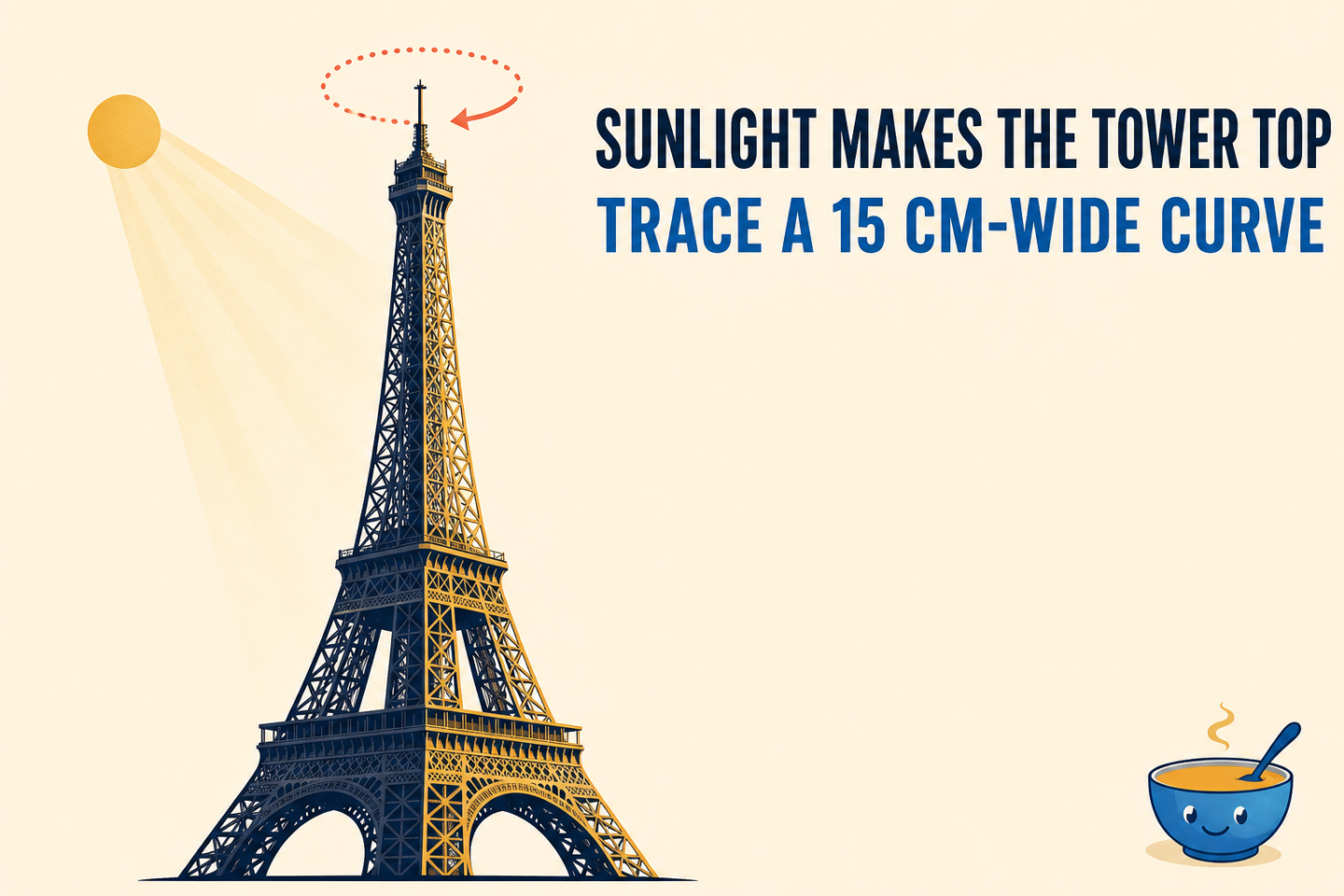
On a clear day, the Sun does more than illuminate the Eiffel Tower. It can make the top of the iron structure trace a roughly circular curve about 15 centimeters in diameter.
That movement comes from uneven heating. Sunlight strikes one of the Tower’s four sides while the others remain less heated. The difference produces a slight lean away from the Sun, and the changing position of the Sun shifts the direction of that lean during the day.
What the 15 centimeters actually measures
The most important detail is what the number describes. The official Eiffel Tower account says the top can move through a more or less circular curve measuring approximately 15 centimeters in diameter. In other words, 15 centimeters is the width of the path traced by the top. It is not 15 centimeters added permanently to the Tower’s height, and it is not a claim that the entire structure bends that far in one direction.
The distinction matters because a dramatic number can easily create the wrong mental picture. The Tower is not visibly lurching across the Paris skyline. The official account describes the changes as infinitesimal and imperceptible to visitors and observers.
Why one sunny side changes the balance
The Eiffel Tower is made of puddled iron, a metal that responds to temperature. When a material warms, thermal expansion can increase its volume. If every side of the Tower warmed in exactly the same way, the effect would be more even. Direct sunlight, however, illuminates one side while the other three remain comparatively stable.
That uneven exposure creates an imbalance. The sunlit side responds to the heat, and the structure tilts slightly away from the Sun. As the Sun appears to move across the sky, the heated side changes. The top therefore follows a curved route rather than simply remaining displaced in one fixed direction.
Daily movement is not seasonal height change
The official explanation describes another temperature effect that should not be confused with the 15-centimeter curve. In warm conditions, thermal expansion can make the Tower a few millimeters taller. In cold winter weather, the iron contracts and the structure can lose a few millimeters.
Those seasonal height changes and the daily sun-driven lean share the same broad physical idea: iron responds to temperature. But they describe different measurements. One concerns a small change in height; the other concerns the path traced by the top as unequal sunlight shifts around the structure.
A moving tower that looks still
Wind can also make the Tower wobble or vibrate, but the sunlight effect has a different cause. It begins with unequal heating across the iron structure. The movement is tiny, natural, and accounted for by the way the material responds to its environment.
The memorable part is not that the Eiffel Tower visibly sways in sunshine. It is that an apparently motionless landmark is quietly changing throughout the day. At the scale of a 330-meter structure, a path only about 15 centimeters wide is enough to reveal the physics hidden inside a familiar silhouette.