
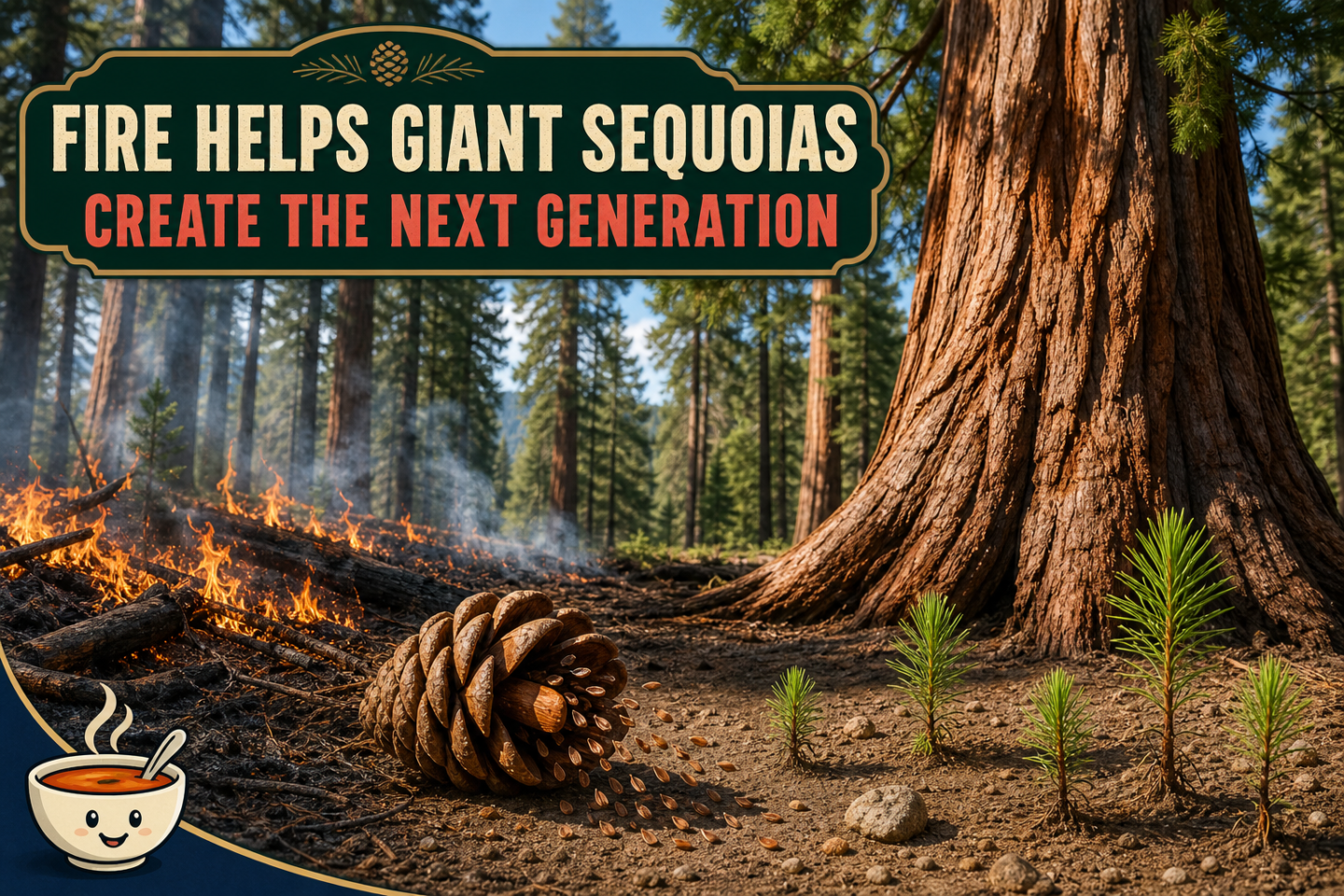
Fire may seem like the natural enemy of a tree, yet giant sequoias have a deep ecological relationship with it. These enormous conifers are adapted to recurring fire, and the next generation often depends on the conditions that lower- and mixed-severity burns leave behind.
The relationship is not as simple as saying that all fire is good. Giant sequoias can be killed by unusually severe burns. But in a forest shaped by frequent surface fire, heat, cleared ground and openings in the canopy work together to create a nursery for new trees.
How does bark protect a giant sequoia?
A mature giant sequoia’s reddish bark can become remarkably thick. Its fibrous structure contains little resin and acts as insulation between the heat of a surface fire and the tree’s living tissues. The largest trees also tend to carry their more flammable branches high above the ground.
Those traits do not make a sequoia fireproof. Flames can enter old scars or cavities, repeated injuries can weaken the base, and extreme fire can reach the crown. The adaptations are best understood as defenses against the recurring fires that historically moved through sequoia groves at varying intensities.
What does fire do for the seeds?
Giant sequoia cones can remain on a tree for years while holding many tiny seeds. Heat and drying help the cone scales open, allowing the seeds to fall. A seed is only the beginning, however. It also needs a suitable place to germinate.
An unburned forest floor may be covered by leaves, needles and woody debris. Fire consumes part of that layer and exposes patches of mineral soil. Seeds that land there have better contact with the ground and face less immediate competition from dense surface vegetation.
Fire can also kill or thin smaller trees in localized patches. The resulting gaps allow more sunlight to reach the forest floor. Giant sequoia seedlings need abundant light, so a sunny opening can make the difference between a seedling that establishes and one that disappears beneath the shade.
Why did fewer fires mean fewer young trees?
Tree-ring records show that surface fires were a frequent feature of giant sequoia ecosystems for centuries. That pattern changed as Indigenous burning declined and government agencies emphasized fire suppression. With fewer fires, fuels accumulated, the understory became denser and the conditions needed for sequoia seedlings appeared less often.
National Park Service research found a major failure of giant sequoia reproduction during much of the twentieth century. Mature trees could remain standing for a very long time, making a grove look stable, while relatively few young trees were advancing to replace them.
Managers eventually began restoring fire to some groves through carefully planned prescribed burns. These are not casual fires. Qualified crews work within defined boundaries and selected weather conditions, monitor flame behavior and prepare plans for containment and public safety.
When can fire become destructive?
The fire that supports regeneration is not the same as an uncontrolled wall of flame consuming an entire canopy. Fire intensity varies across a landscape. A healthy historical pattern could include many low-severity areas, some moderate effects and smaller patches of higher intensity that opened the canopy.
After long periods without fire, logs, branches, leaf litter and dense vegetation can build up. Dry conditions can then help a fire burn with far greater severity. Even the thick bark of an ancient sequoia cannot guarantee survival when flames reach the crown or burn intensely around the base.
This distinction matters when describing fire ecology. Giant sequoias are adapted to repeated fire, but they are not adapted to every possible fire. Frequency, weather, fuel, terrain and intensity all shape the outcome.
A forest process, not a single event
Giant sequoia regeneration depends on a sequence of connected changes. Cones release seeds. Litter is removed. Bare soil appears. Openings admit sunlight. Some seedlings establish, and only a small fraction survive long enough to become towering adults.
Fire is one part of that cycle, alongside water, temperature, insects, competition and time. Its role becomes visible when we look beyond the dramatic flames and examine what happens on the forest floor afterward.
A giant sequoia can live for thousands of years, but the persistence of a grove depends on more than the survival of its oldest trees. It also requires the right conditions for tiny seeds to begin again. In these forests, recurring fire has long helped create those conditions.