
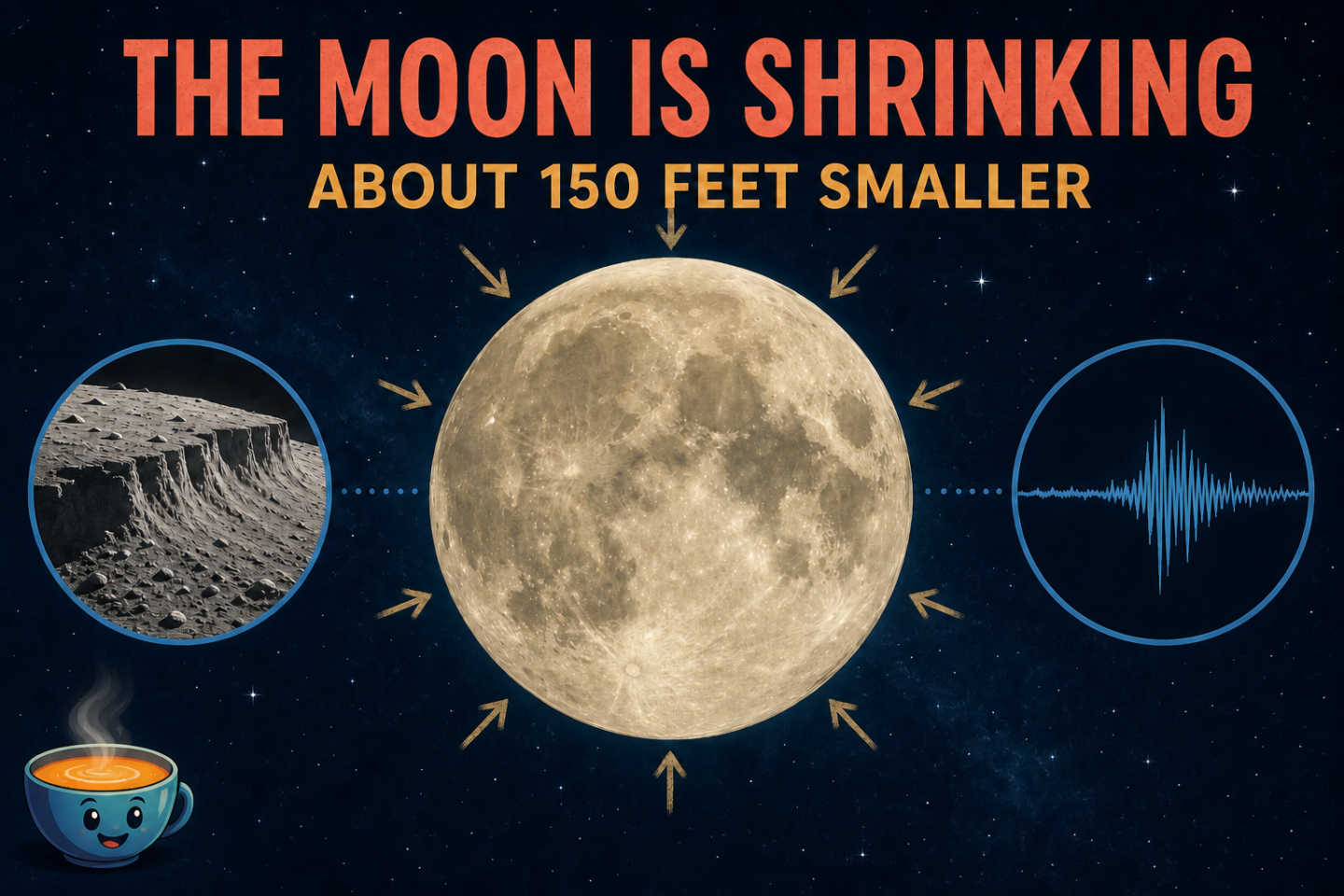
The Moon looks calm and unchanging from Earth, but it is still geologically active. Its interior has been losing heat for billions of years. As the Moon cools, it contracts slightly, stressing its rigid outer layers and helping create faults that can still move today.
NASA estimates that this long process has reduced the Moon’s diameter by about 150 feet, or roughly 50 meters, over the last several hundred million years. That is a measurable change, yet it is tiny compared with the Moon’s diameter of about 2,159 miles. No observer could watch the lunar disk become visibly smaller.
Why does cooling make the Moon contract?
The Moon formed more than four billion years ago from hot material. Much of its early internal heat came from its formation and from the decay of radioactive elements. Although the lunar surface became cold long ago, heat has continued to escape slowly from the interior.
Most materials contract as they cool. The Moon does too, but its outer shell is not soft enough to adjust smoothly. The crust and upper mantle behave more like brittle rock. When the interior occupies slightly less volume, the outer layers must accommodate the change by breaking and shifting.
The result is a network of thrust faults. At these faults, the crust is compressed and one block is pushed up and over another. On the surface, this motion creates narrow, cliff-like landforms called lobate scarps. Images from NASA’s Lunar Reconnaissance Orbiter have revealed thousands of these scarps across the Moon.
How can a shrinking Moon cause moonquakes?
A fault does not always slide steadily. Friction can hold the rock in place while stress accumulates. When the stress overcomes that resistance, the fault can slip and release energy as seismic waves. On Earth we call the resulting vibration an earthquake; on the Moon it is a moonquake.
Astronauts in the Apollo program placed seismometers on the lunar surface. Those instruments recorded several types of seismic activity, including deep moonquakes linked to tidal forces, vibrations caused by meteorite impacts, thermal quakes related to large temperature changes and shallow moonquakes associated with the Moon’s crust.
Shallow moonquakes are especially relevant to contraction because some occur near young thrust faults. NASA scientists have compared the locations of Apollo-era shallow moonquakes with mapped fault scarps and modeled how stresses from tidal forces act on those faults. The evidence indicates that at least some faults remain active.
Is the Moon about to disappear?
No. The phrase “the Moon is shrinking” can sound dramatic, but the scale matters. A decrease of about 150 feet in diameter spread across several hundred million years is extraordinarily gradual. The Moon remains approximately 2,159 miles wide, and its orbit, phases and familiar appearance are not being transformed by this contraction.
The 150-foot estimate also describes accumulated change over geologic time, not a sudden event. The arrows often used in diagrams are visual shorthand for compression; they should not be interpreted as something visible through a telescope.
The process does matter scientifically. It shows that a world often described as geologically dead still stores and releases stress. Understanding active faults is also useful when scientists consider the long-term placement of equipment, habitats or other infrastructure on the lunar surface.
Why do the fault scarps look young?
Lunar surface features can preserve evidence for very long periods because the Moon has no wind, rain or flowing rivers to erase them. Even so, small meteorite impacts gradually churn the soil and soften sharp landforms.
Some lobate scarps cut across relatively young craters and have crisp edges that have not been heavily worn down by impacts. In places, boulders and soil appear to have moved down scarp faces. These details support the conclusion that contraction and fault movement continued into the Moon’s recent geologic past.
Recent in this context still means a very long span by human standards. Planetary scientists use surface relationships, crater counts, orbital images and seismic records together to reconstruct when a feature formed and whether it may still be active.
A small change with a large scientific message
The Moon’s slow contraction is a reminder that planetary bodies do not simply switch from active to inactive. Their interiors cool over immense spans of time, and their surfaces preserve the consequences.
About 150 feet of lost diameter is almost nothing beside the size of the Moon. Yet the thrust faults and moonquakes associated with that change reveal a world still adjusting to the heat of its ancient origin. The Moon may look timeless in the night sky, but even it continues to change.