
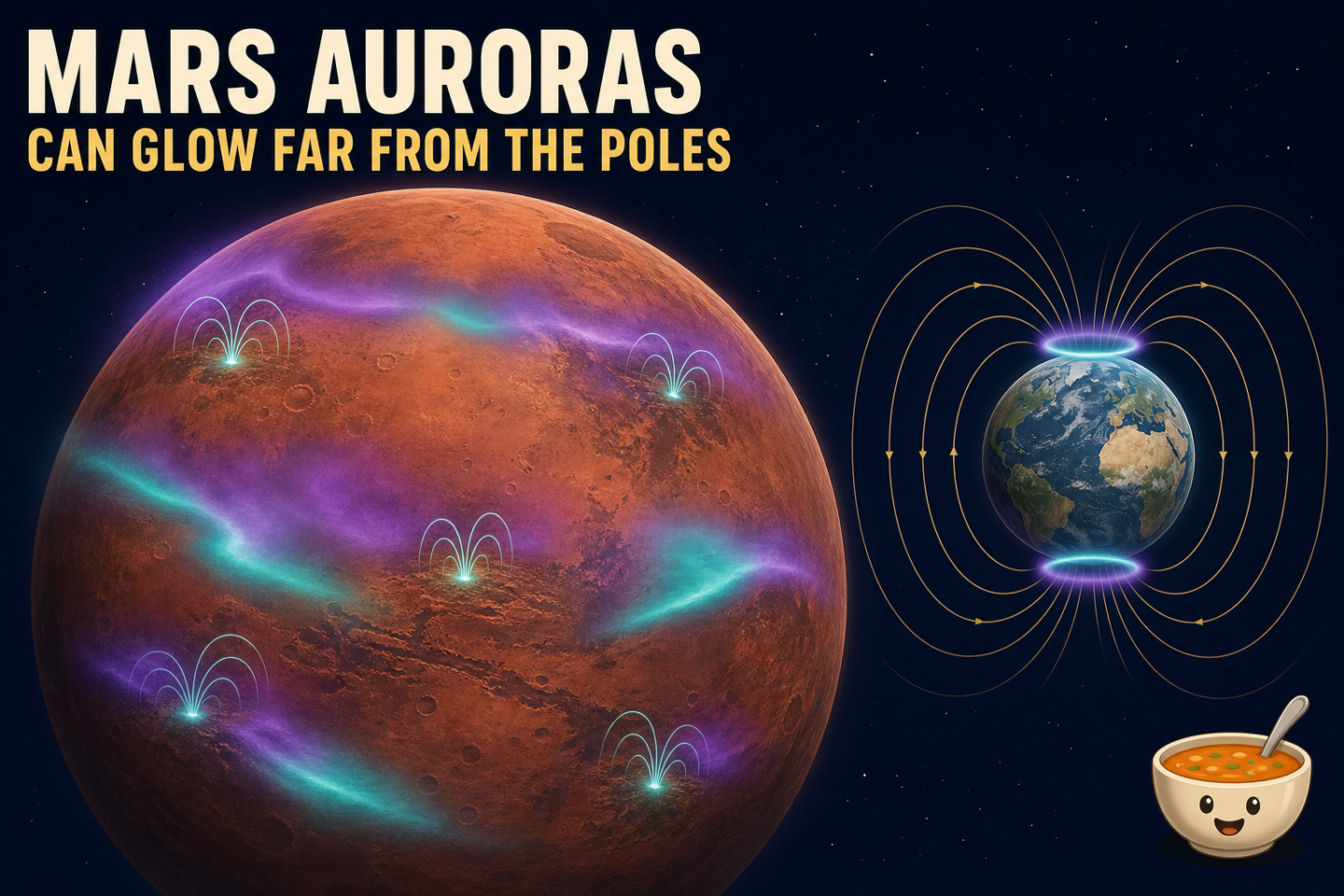
On Earth, the words “northern lights” and “southern lights” make aurora sound inseparable from the poles. Mars breaks that familiar pattern. It has no global magnetic field surrounding the whole planet, so energetic particles are not consistently steered toward two polar regions. Some Martian auroras can appear across broad areas, while others are linked to isolated patches of magnetized crust.
The key is that aurora geography depends on more than a planet’s atmosphere. It also depends on the magnetic routes that charged particles follow before they collide with atmospheric gases and release light.
Earth supplies the familiar polar model
Earth’s churning liquid-metal core generates a large magnetic field. That field forms a magnetosphere around the planet and guides many charged particles toward high latitudes. When accelerated particles enter the upper atmosphere and collide with atoms and molecules, those gases can emit light.
This is why Earth’s most familiar auroral displays cluster around oval-shaped regions near the Arctic and Antarctic. The magnetic field does not create the particles or the atmospheric glow by itself; it strongly influences where the particles travel.
Mars has magnetic patches instead of one global field
Mars does not have a comparable planet-wide magnetic shield. NASA describes umbrella-shaped magnetic fields that rise from magnetized sections of the crust, particularly in parts of the southern hemisphere. These patches are remnants of an ancient global field preserved in old rocks.
That makes the planet’s magnetic geography more like a patchwork than a single north-to-south system. Near some crustal fields, incoming particles can be guided into the atmosphere and produce localized, or discrete, auroral glows. Those displays may be associated with particular magnetic regions rather than with the geographic poles.
Some Martian auroras can be widespread
Localized aurora is only part of the story. NASA’s MAVEN spacecraft observed ultraviolet aurora that was widespread across Mars’s northern hemisphere and was not tied to one geographic location. During a strong solar storm in 2017, MAVEN recorded auroral emission across the planet.
In that case, energetic particles from the storm bombarded gases in the Martian atmosphere and made them glow. Because Mars lacks a strong global field to concentrate the particles near the poles, the illumination was not confined to polar rings.
This does not mean every Martian aurora covers the whole planet. Mars has several aurora mechanisms, and their patterns differ. The honest correction is not “Mars has global auroras instead of polar ones.” It is that the Earth model is too narrow: on Mars, auroras can be localized, widespread, or associated with other particle processes depending on the event and magnetic environment.
There is also a visibility limit. Many Martian auroras have been detected in ultraviolet light rather than as a bright show for human eyes. “Aurora” describes atmospheric emission produced by energized particles, but its wavelength and brightness determine what an observer could actually see. The colors in explanatory illustrations are therefore symbolic, not a forecast of a naked-eye Martian sky.
Why the comparison matters
Auroras are often presented as atmospheric light shows, but they are also maps of invisible interactions. Their location and shape reveal how solar particles, magnetic fields, and an atmosphere meet.
Earth’s polar ovals reflect a strong global field. Mars’s broader and patchier displays reflect a world whose ancient global magnetism largely vanished, leaving magnetized crust behind. The glow may look like the headline, but the deeper story is the magnetic architecture underneath it.