
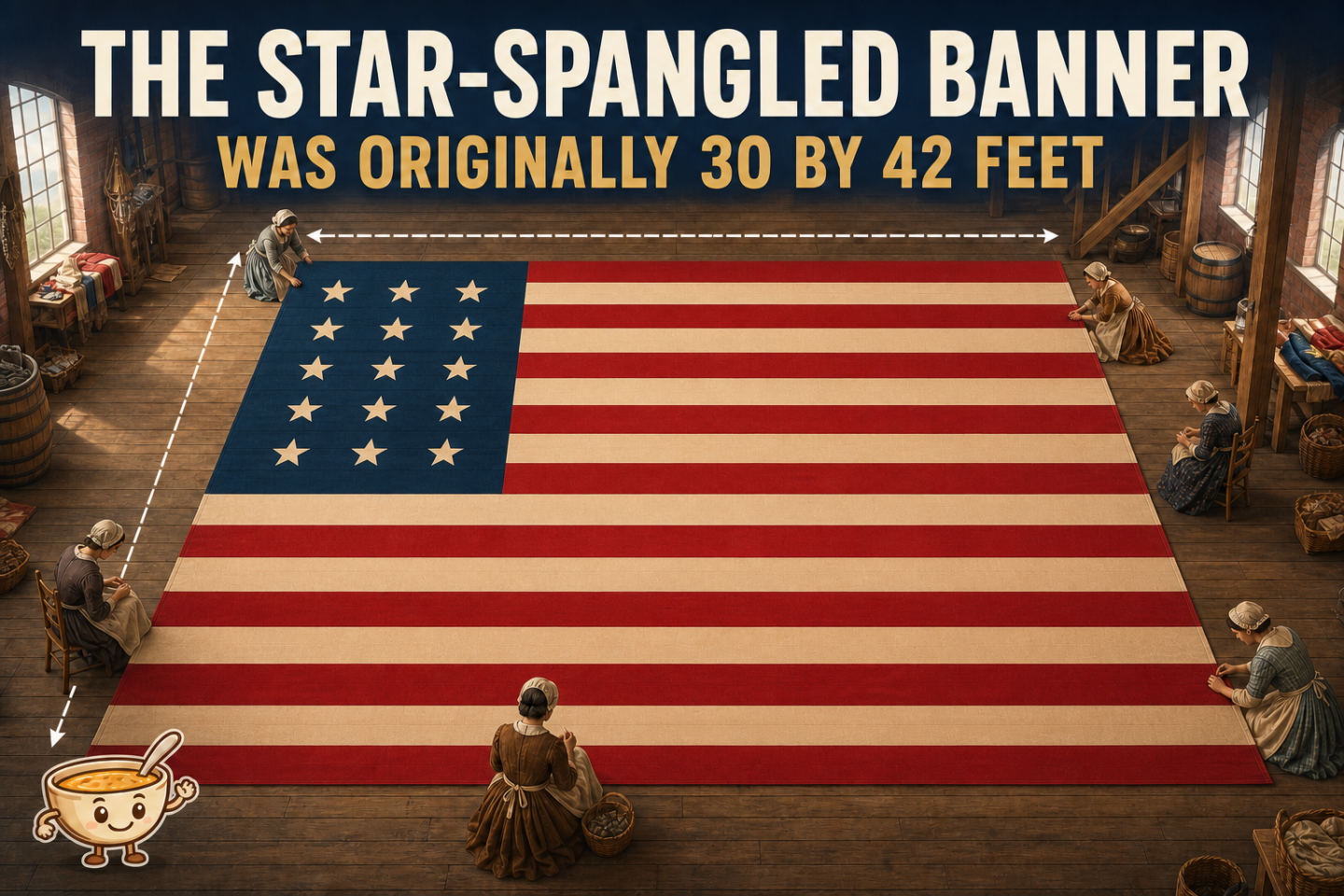
The flag that inspired the U.S. national anthem was enormous because it was meant to be visible from a distance. In the summer of 1813, Fort McHenry’s commander ordered a garrison flag measuring 30 by 42 feet, along with a smaller storm flag for bad weather.
The larger flag was not merely ceremonial decoration. Baltimore was preparing for a possible British attack during the War of 1812, and a large flag would make the fort’s identity unmistakable. Its practical purpose produced an object whose physical scale later became inseparable from the story of The Star-Spangled Banner.
A Flag With a Job to Do
Major George Armistead, the fort’s commanding officer, wanted a flag that could be seen clearly from far away. The order therefore called for two flags: a 30-by-42-foot garrison flag and a 17-by-25-foot storm flag. The smaller flag could be flown in harsher weather, while the much larger one offered maximum visibility when conditions allowed.
The dimensions are easier to grasp as an area. Multiplying 30 feet by 42 feet gives 1,260 square feet of fabric. That calculation describes the flag’s original rectangular footprint, not the amount of material purchased or the size of the surviving object today. Even without an invented comparison, the number explains why ordinary sewing-room space was not enough.
Seven Weeks of Work
The commission went to Mary Pickersgill, a Baltimore ship and signal flag maker. According to the National Park Service, she worked for seven weeks with a team that included her daughter Caroline, her nieces Eliza and Margaret Young, and Grace Wisher, a thirteen-year-old African American indentured servant. Pickersgill’s mother, Rebecca Young, may also have helped. Several members were teenagers: Caroline and Eliza were 13, Margaret was 15, and Grace was 13. Naming them makes the labor behind the enormous object visible rather than treating it as the work of one person alone.
The team joined strips of loosely woven English wool bunting. To spread out the immense flag, they used the floor of a brewery near Pickersgill’s home and workshop. This detail turns an abstract measurement into a scene: a flag intended for a fort had to leave the flag maker’s own workspace before it could be laid out at full size.
The design also reflects the United States of its time. The garrison flag had 15 stars and 15 stripes, following the then-current practice of adding both a star and a stripe when a state joined the Union. Each stripe was two feet wide. Each star measured 24 inches from point to point. The flags were completed on August 19, 1813.
The Flag Seen in 1814
More than a year later, the large garrison flag became part of a different story. Francis Scott Key saw it over Fort McHenry on the morning of September 14, 1814, after the bombardment of the fort. The sight inspired him to write the words that became The Star-Spangled Banner.
There is an important distinction between the two flags. Many historians believe the smaller storm flag flew during the rainy bombardment, but that flag has been lost. The National Park Service identifies the 30-by-42-foot garrison flag as the flag Key saw that morning. That is the surviving object now associated with his song and displayed by the Smithsonian’s National Museum of American History.
Why the Size Still Matters
The famous dimensions were not a later attempt to make a national symbol more dramatic. They came from the flag’s original job: to communicate the fort’s presence across a great distance. The labor, the brewery floor, the two-foot stripes, and the carefully assembled stars all followed from that requirement.
That practical origin is the memorable payoff. A military signal commissioned in 1813 became the physical sight behind a song in 1814, and the song later became the national anthem. The flag’s scale helps connect those stages because it explains both why people made such a huge object and why it could command attention when it flew above the fort.