
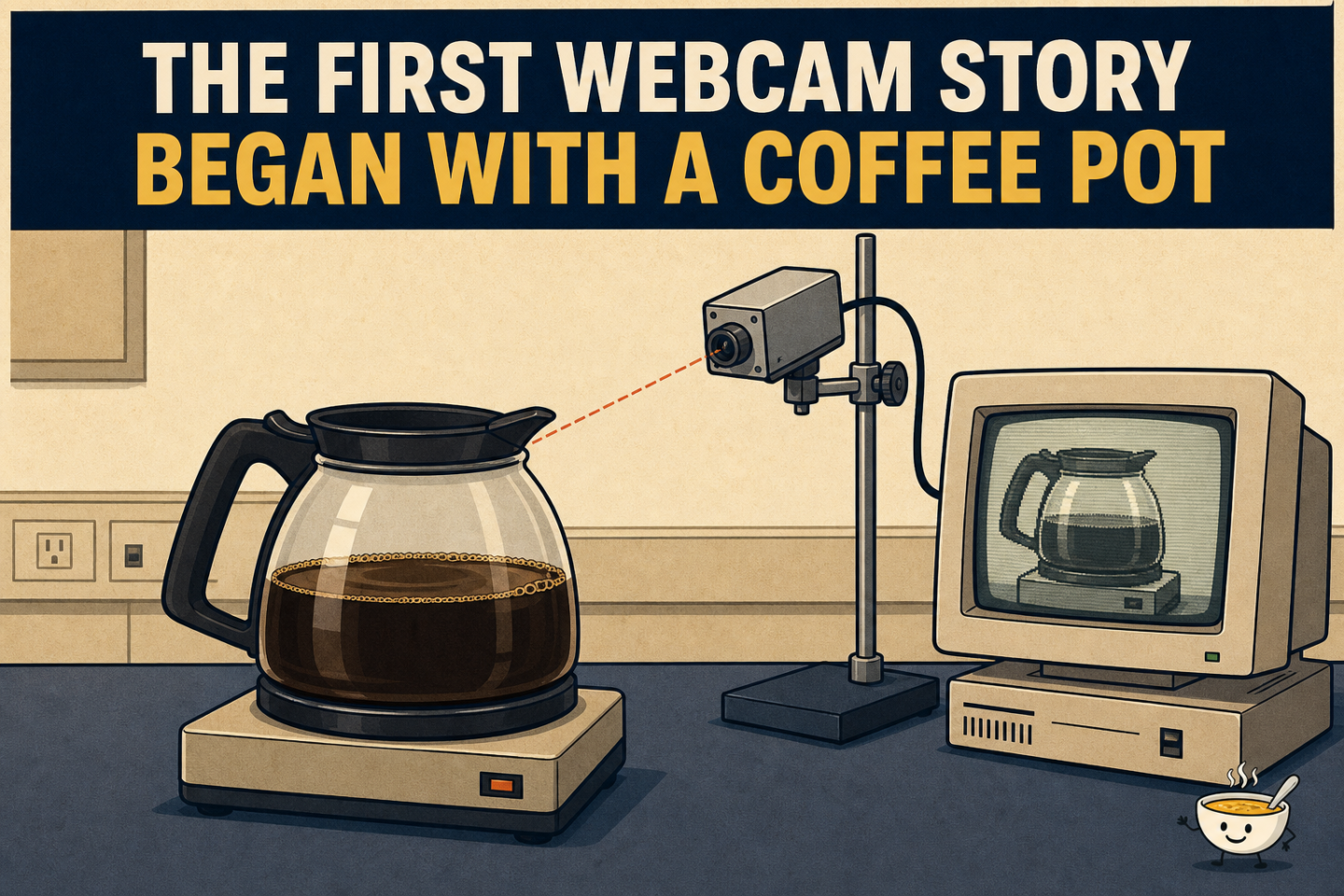
The first webcam began with a problem that was almost comically small: researchers kept walking to a shared coffee pot only to find it empty. In late 1991, a group at the University of Cambridge Computer Laboratory aimed a camera at the Trojan Room pot and wrote software that let colleagues check it from their workstations. The system was useful immediately, but it was not yet on the World Wide Web.
That distinction is the heart of the story. The 1991 project, called XCoffee, sent changing grayscale images across the laboratory’s own network to a custom viewing program. In November 1993, Dan Gordon modified the system so it could answer Web requests and, with Martyn Johnson, connected it to the Web. According to Cambridge’s timeline, that change transformed XCoffee into the first webcam.
A wasted walk created the problem
About fifteen researchers shared one filter coffee machine near the Trojan Room. Some worked two or three flights of stairs away. A fresh pot could disappear before a distant colleague arrived, turning a coffee break into a fruitless trip through the building.
The group already had useful hardware nearby. A video frame-grabber was attached to one of the computers used for network testing. The researchers fixed a camera to a laboratory stand, pointed it at the coffee machine, and ran wires beneath the floor to the frame-grabber. The setup was improvised, but the image had one clear job: show whether coffee was available.
XCoffee was networked before it was on the Web
Paul Jardetzky wrote a server program that captured images of the pot every few seconds. Quentin Stafford-Fraser wrote a client program that colleagues could run on their workstations. It displayed an icon-sized view of the pot in a corner of the screen.
The picture was grayscale and updated only about three times per minute. Those limitations sound severe beside modern video calls, but the coffee level changed slowly. The system did not need smooth motion, high resolution, or color to answer its single question. It was a practical example of matching a technical design to the speed of the thing being observed.
Why 1993 changed its identity
The early Web was rapidly gaining the ability to display images inside pages. Cambridge’s timeline notes that an image tag was proposed for HTML in February 1993 and that a beta version of the Mosaic browser supported embedded images in March. A camera server could now return a newly captured image whenever a browser asked for one.
Gordon adapted the coffee-pot system to respond to those Web requests. The custom laboratory client was no longer the only way to see the pot; a standard Web browser could request the image. That made the view available far beyond the original group and turned a local convenience into a public Internet landmark.
This is why saying simply that the webcam was “invented in 1991” loses an important layer. The camera and networked image service existed in 1991. The Web-facing version—the first webcam in Cambridge’s own account—arrived in November 1993. The story is not a contradiction between two dates but a two-stage evolution.
A tiny system with a durable lesson
The Trojan Room coffee pot is remembered because it made a new medium understandable. Instead of a grand demonstration, people saw a familiar object whose condition changed during the day. The image showed that the Web could connect a browser to the current state of something happening elsewhere.
Modern webcams deliver color video, sound, and millions of pixels. XCoffee offered a tiny grayscale still image several times a minute. Yet its design was already recognizably modern: a camera observed a remote place, a server supplied updated visual information, and a viewer checked the result from another screen. The hardware was modest; the pattern was powerful.
The enduring payoff is not that coffee somehow caused online video. It is that a mundane inconvenience gave researchers a reason to connect sensing, networking, and the Web. Sometimes a technology becomes memorable not because its first task was grand, but because its first task was instantly human.