
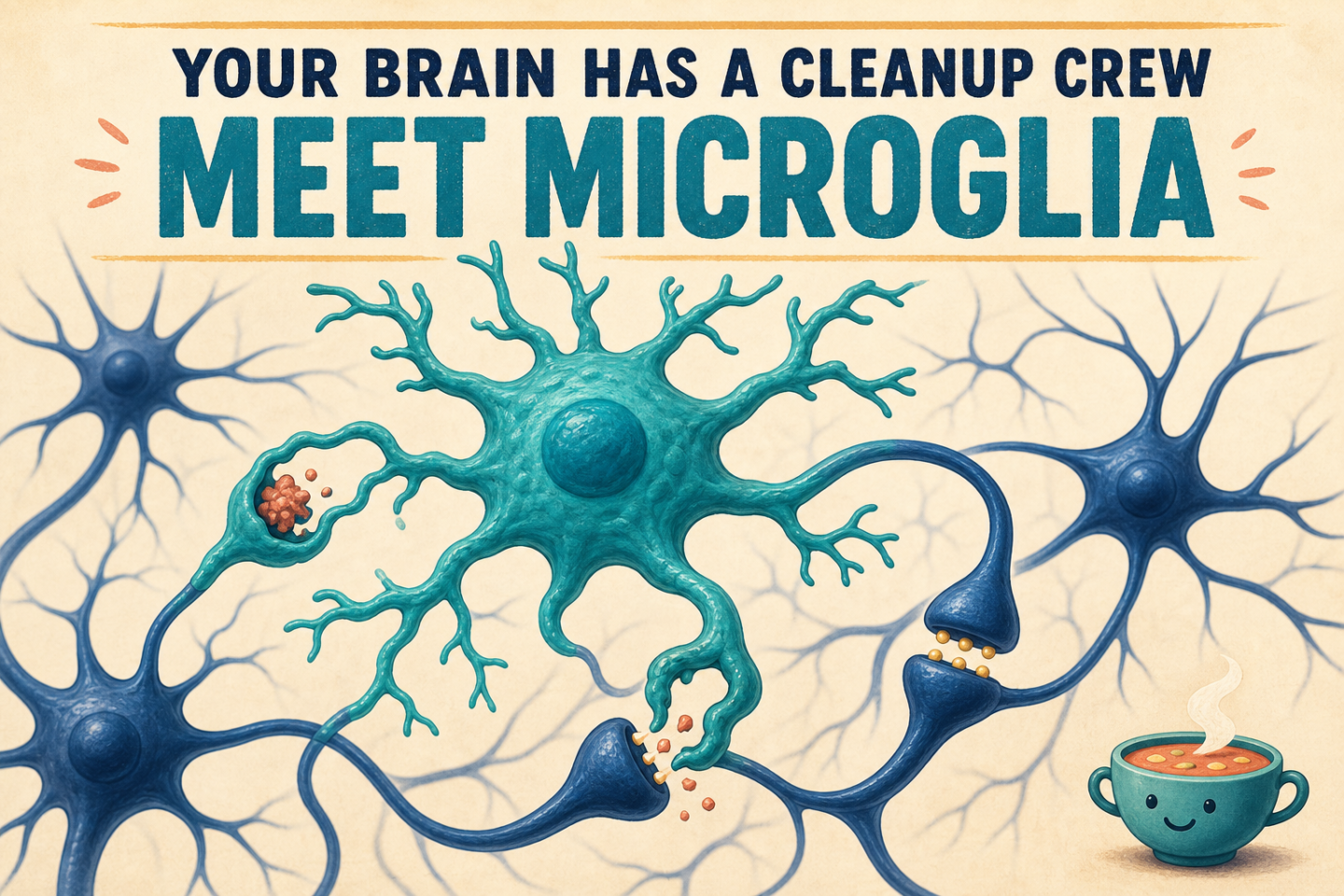
Your brain has a cleanup crew, but it does not carry brooms. The crew is made of microglia: immune cells that live in brain tissue. They patrol their surroundings, respond when something is wrong, and help remove cellular debris.
That is only the first layer of their job. Microglia also remove dying neurons, help prune synapses, and support the survival of healthy neurons. In other words, they are not simply emergency responders. They are part of the brain’s everyday maintenance system.
A resident immune cell inside the brain
Neurons get most of the attention because they send electrical and chemical signals. Microglia belong to a different family of brain cells called glia. The National Institute on Aging describes microglia as immune cells in the brain. Under normal conditions, they help maintain healthy neurons and patrol the brain environment for invaders and cellular debris.
“Patrol” is a useful way to picture the work, as long as it is treated as a metaphor. A microglial cell is not moving through an empty hallway. It occupies crowded living tissue and continuously interacts with chemical signals, nearby cells, and material that may need to be removed.
Cleanup can include remodeling connections
The word cleanup may sound as if microglia only collect waste. Their maintenance role is broader. The National Institute on Aging notes that microglia remove dying neurons, prune synapses, and generally support neuron survival.
A synapse is a specialized junction where a neuron communicates with another target cell, according to the National Library of Medicine’s MeSH record. The brain creates and changes enormous numbers of these junctions. Pruning helps remove connections that are no longer needed, while useful networks remain. Describing that process as trimming is another metaphor, not a claim that the cells use miniature tools.
This connection-remodeling role is one reason “trash collector” is memorable but incomplete. Microglia do dispose of unwanted material, yet they also participate in shaping and maintaining the environment in which neurons work. That background work is continuous, local, and highly selective.
Maintenance begins early and continues through life
Microglia are not temporary visitors that appear only after an injury. The Eunice Kennedy Shriver National Institute of Child Health and Human Development describes them as immune cells responsible for the development and maintenance of a healthy brain throughout life.
Their behavior is not one fixed setting. In a calm environment, microglia survey and maintain tissue. When they encounter trouble, they can engulf material and release signals that help coordinate an immune response. That flexibility is useful, but it also means that a single cartoon pose can never represent every microglial state.
What the cleanup-crew image gets right
The comparison works because it connects several jobs: surveillance, debris removal, maintenance, and selective remodeling. It fails if it suggests that microglia are outside helpers entering a passive brain. They are resident cells and part of the system itself.
So the lasting fact is not merely that the brain contains immune cells. It is that healthy brain function depends on more than neurons sending messages. Behind those messages is a living maintenance network, and microglia are one of its essential working parts.